Introduction
Financial advisors carry a double workload most professionals never face: they must conduct credible investment research and translate that research into clear, confident conversations — often on the same day, without a dedicated research team behind them.
The explosion of data platforms and AI-driven tools has raised the stakes. The wrong research stack quietly drains hours that should go toward clients. The right one compresses prep time, sharpens credibility, and keeps every meeting on track.
That pressure is amplified by firm size. According to IAA data, 92.7% of SEC-registered advisers have 100 or fewer employees, and 68.5% manage less than $1B in assets. For most advisory firms, there's no dedicated research analyst — the tools you choose are your research team.
This guide covers five investment research tools most relevant to financial advisors in 2026: what each does best, where it falls short, and who it's actually built for.
Key Takeaways
- Research tools fall into distinct categories — market data, portfolio analytics, and client communication — and no single platform covers every need
- Client-facing simplicity matters more than institutional-grade depth alone — advisors need tools that translate data into clear conversations
- A strong advisor stack combines a core data/analytics platform with a dedicated client communication layer
- Pricing ranges from free (Koyfin) to ~$30,000/year (Bloomberg Terminal) — matching tools to practice size matters as much as matching on features
What Financial Advisors Actually Need in a Research Tool
Most research platforms are built for one type of user. Bloomberg was built for traders. Morningstar was built for analysts. The advisor workflow is different — it demands both sides of the research equation.
Three needs define the advisor use case:
- Reliable, current market and fund data — accurate enough to support investment recommendations and client conversations
- Compliant, presentation-ready materials — reports and visuals that can go directly in front of clients without hours of reformatting
- Time efficiency — most advisors work without a dedicated research associate handling prep work
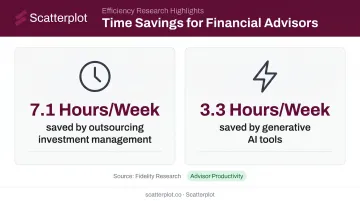
Fidelity research estimates that outsourcing investment management saves advisors 7.1 hours per week, and generative AI tools save another 3.3 hours per week. That context matters when evaluating any platform: tools that add manual workflow steps carry a real cost in time, not just in dollars.
Independent and boutique advisors feel all three constraints most acutely. They need institutional-quality insights without enterprise-level complexity, cost, or implementation overhead — which makes the choice of platform a practical, day-to-day decision, not just a procurement exercise.
Best Investment Research Tools for Financial Advisors in 2026
Each tool below was evaluated on data reliability, advisor-specific functionality, ease of use, client communication support, and value relative to cost.
Morningstar Direct Advisory Suite (formerly Advisor Workstation)
Morningstar's platform is one of the most widely adopted all-in-one research environments for advisors, combining fund screening, portfolio analysis, financial planning, and proposal generation in a single workflow.
Its strength is breadth — deep coverage of mutual funds, ETFs, and fixed income assets alongside compliance-ready reporting and integration with major CRM and financial planning platforms. The Portfolio X-Ray tool deconstructs holdings by asset allocation, investment style, geographic exposure, and sector, useful for both advisor analysis and client-facing explanations.
| Category | Details |
|---|---|
| Key Features | Fund and ETF screener, Portfolio X-Ray, financial planning integration, FINRA-reviewed report templates, investment policy statement tools, proposal generation |
| Pricing | Quote-based; no public standard pricing. Contact Morningstar directly for current rates |
| Best For | Advisors who need a broad-based research and planning platform with compliance-ready reporting and strong fund data coverage |
Notable limitation: Morningstar does not publish standard pricing — advisors will need to request a quote, which makes it harder to evaluate cost upfront.
Bloomberg Terminal
Bloomberg remains the industry benchmark for real-time financial data — equities, fixed income, commodities, currencies, derivatives, news, and filings. Its 350,000+ global users include wealth managers, asset managers, and family offices.
Bloomberg has added meaningful AI capabilities, including ASKB (launched February 2026), AI news summaries from 30,000+ sources, and AI-powered document search. For advisors managing complex multi-asset portfolios at larger firms, this depth is unmatched.
The trade-off is cost and complexity. A WSJ report benchmarks Bloomberg at roughly $30,000/year per terminal — a figure that puts it out of reach for most independent advisors.
| Category | Details |
|---|---|
| Key Features | Real-time multi-asset data, earnings transcripts, news analytics, Bloomberg Chat, fixed income and derivatives analytics, ASKB AI assistant |
| Pricing | ~$30,000/year per terminal (secondary source; Bloomberg does not publish official pricing) |
| Best For | Advisors at institutional or larger wealth management firms managing complex, multi-asset portfolios who need comprehensive real-time data |
YCharts
YCharts was built specifically to make investment research more accessible and visual for advisors and asset managers. Its data library pulls from sources including Morningstar (50 years of pricing, 30 years of fundamentals for 20,000+ companies) and S&P Global for estimates.
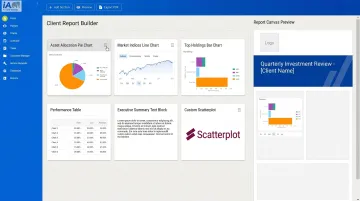
The platform's clearest differentiator is its advisor-facing output: drag-and-drop client report templates, branded presentation materials, and a data visualization interface designed for communication — not just analysis. An AI chat assistant is also included.
| Category | Details |
|---|---|
| Key Features | Fundamental charting, stock and fund screeners, model portfolios, client report templates, economic data series, AI chat assistant, Excel integration |
| Pricing | Analyst: $3,000/year (first seat); Professional: $6,300/year (first seat); Presenter and Enterprise pricing available upon request |
| Best For | Advisors who prioritize visual data communication, client reporting, and comparative portfolio analysis |
Notable limitation: YCharts does not list earnings transcripts or full broker research reports among its documented features — advisors needing qualitative research depth will need to supplement.
Koyfin
Koyfin positions itself as the cost-effective alternative to Bloomberg, covering equities, ETFs, mutual funds, fixed income, macro indicators, forex, and crypto across 80,000+ companies. The interface is designed for quick navigation, and its data depth rivals more expensive platforms for quantitative research.
The Advisor Core and Advisor Pro tiers add client reporting and custodian integration capabilities at prices most independent advisors can absorb. A free tier also exists — genuinely useful for advisors who want to test before committing.
| Category | Details |
|---|---|
| Key Features | Advanced charting, stock and ETF screeners, macro dashboards, sector heatmaps, portfolio tracking, advisor-specific reporting tiers |
| Pricing | Free: $0/mo; Plus: $39/mo; Premium: $79/mo; Advisor Core: $209/mo; Advisor Pro: $299/mo (annual plan pricing) |
| Best For | Independent advisors or small RIAs who need broad quantitative coverage and solid charting at a more accessible price point |
Notable limitation: Qualitative research depth — earnings call analysis, expert networks, broker research — is limited compared to premium platforms.
Scatterplot
Scatterplot addresses a gap the other tools on this list leave open: turning research into client-ready presentations.
Built specifically for wealth managers and financial advisors, Scatterplot delivers a daily-updated library of branded investment visuals — market and economic charts, custom slides, and guided talking points — ready to use in client meetings without any chart-building or deck-polishing required.
Most research platforms stop at the data. Scatterplot delivers the presentation layer directly. Slides are customized with the advisor's logo, colors, and compliance disclosures, and guided talking points are included to support confident, clear client conversations.
At $99/month with a 7-day free trial, it's designed as an accessible complement to any existing research stack — not a replacement for data platforms, but the layer that closes the gap between data and client conversation.
| Category | Details |
|---|---|
| Key Features | Daily-updated market and economic charts, custom-branded slides (logo, colors, disclosures), guided talking points, compliance-ready disclosures, multiple deck management, PDF download or web-based presentation |
| Pricing | $99/month; 7-day free trial included |
| Best For | Financial advisors who want to reduce meeting prep time, enhance client-facing presentations, and communicate market insights clearly without building charts from scratch |
How to Build the Right Advisor Research Stack
Most advisor tech stacks are more fragmented than necessary. The Kitces 2025 AdvisorTech Study found the average advisor uses 15 tools across 20 business functions — and that higher tech spending doesn't consistently correlate with higher satisfaction.
The lesson: don't over-buy. Match tools to actual workflow needs.
Common mistakes advisors make:
- Paying for enterprise platforms with features they'll never use
- Relying on a data platform without solving the client communication gap
- Treating reporting features as equivalent to client-ready presentation materials
The layered stack that works for most advisors:
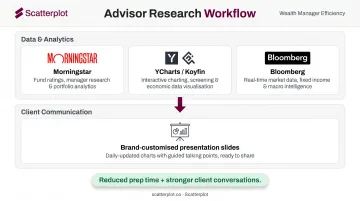
- Data and analytics — Morningstar for planning depth, YCharts or Koyfin for research and quantitative analysis, Bloomberg for institutional-level multi-asset coverage
- Client communication — a tool that converts research into presentation-ready materials without manual chart-building (Scatterplot fills this role)
Together, these layers cover the full advisor workflow. A strong data platform without a communication layer still leaves advisors building decks by hand. When both are in place, preparation time drops and client conversations carry more weight.
Conclusion
The right research tools do more than expand data access. They translate that data into client conversations that build trust, support retention, and reinforce your expertise.
Audit your current stack against both sides of that equation: does it handle the research, and does it handle the presentation of that research? For most advisors, the data side is covered. The gap shows up one step later — where analysis needs to become a clear, branded, client-ready narrative — and that's where preparation time bleeds away.
That's the gap Scatterplot was built to close. The platform delivers daily-updated, branded investment visuals and guided talking points so advisors spend less time assembling decks and more time in front of clients.
Disclaimer
The content on this site is for informational and educational purposes only and does not constitute financial, investment, legal, or tax advice. It should not be relied upon as the basis for any investment decision. Past performance is not indicative of future results. Always consult a qualified financial professional before making any financial decisions.
Frequently Asked Questions
What is the difference between investment research tools for financial advisors vs. institutional investors?
Institutional tools like Bloomberg are built for dedicated research teams conducting deep, multi-asset analysis. Advisor-focused tools prioritize usability, client reporting, and time efficiency, since advisors must both analyze and communicate insights without a dedicated research team behind them.
How much do investment research tools for financial advisors typically cost?
Pricing varies widely depending on the platform and tier:
- Koyfin: Free tier available; paid plans run $39–$299/month
- YCharts: $3,000–$6,300/year for Analyst and Professional plans
- Bloomberg Terminal: ~$30,000/year
- Morningstar Direct Advisory Suite: Quote-based
- Scatterplot: $99/month
What is the best investment research tool for independent or solo financial advisors?
Independent advisors typically benefit most from Koyfin or YCharts for data coverage and analysis, given their accessible pricing and advisor-specific features. Adding a client communication tool like Scatterplot addresses the presentation prep burden that falls entirely on the solo advisor.
Do financial advisors need AI-powered research tools in 2026?
AI features are increasingly standard. Advisors should evaluate them on financial specificity, source transparency, and genuine integration into advisor workflows — the presence of an AI chat feature alone is not sufficient.
How do financial advisors present investment research to clients effectively?
Effective client communication combines accurate, current data with clear visual storytelling. Advisors who use branded charts, structured talking points, and consistent presentation formats run more confident and efficient meetings than those presenting raw data exports.
Can a financial advisor build a complete research stack without Bloomberg Terminal?
Yes. Many independent and boutique advisors combine Koyfin or Morningstar Direct Advisory Suite with a client communication tool, achieving strong research and presentation coverage at a fraction of Bloomberg's cost. Bloomberg is valuable for institutional complexity, not a requirement for most advisor practices.