Introduction
Financial advisors in 2026 are being pulled in three directions at once. Clients expect data-backed clarity during every review meeting. Regulators demand thorough documentation. And robo-advisors are aggressively competing for the same clients — often at a fraction of the cost. And advisors are still expected to grow their books.
The problem is time. Research from Kitces found that advisors spend only about 41% of their time on client-facing activities, with the rest consumed by administrative tasks, data gathering, and meeting preparation. That's more than half a working week spent on work that doesn't directly build relationships or revenue.
The right tech stack changes that equation. This article covers 10 tools across the most critical functions of advisory practice management — from financial planning software and portfolio reporting to client presentation tools and compliance tech. Each section helps advisors identify where their current setup has gaps and where the right tool makes the biggest difference.
Key Takeaways
- The right tools give advisors back hours each week — time that goes directly into client relationships and growth.
- In 2026, a complete advisor tech stack covers 10 categories — from CRM and financial planning to tax, estate planning, and client presentations.
- Evaluate every tool on integration capability, data security, ease of use, and scalability.
- Scatterplot fills a clear gap in the stack: client-ready, branded market visuals that make every review meeting more data-driven and easier to navigate.
Why Financial Advisors Need the Right Tech Stack in 2026
A financial advisor tech stack is the integrated set of software tools that powers a practice from initial prospecting through ongoing client service — CRM, planning software, portfolio tools, and everything in between.
The pressure to modernize is accelerating. Broadridge's 2026 Digital Transformation Study found that advisors are increasingly signaling demand for more technology and AI-enabled tools, with firms that lag in adoption losing ground on both efficiency and client experience. Billion-dollar RIAs are already accelerating AI and data investments as a core growth strategy.
What's pushing adoption across firm sizes:
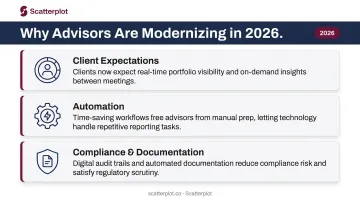
- Clients now expect digital access, real-time portfolio visibility, and proactive communication between meetings — not just an annual review
- Automation handles tasks that once consumed hours of advisor time, from tax return scanning to meeting transcription
- Documentation requirements keep expanding, making audit trails and secure record-keeping non-negotiable for any compliance-conscious practice
The 10 tools below were selected based on market adoption, integration depth, and measurable impact on advisor efficiency — covering categories from CRM and planning software to client communication and compliance.
10 Must-Have Financial Advisor Tools in 2026
These tools span core operational categories. Selection is based on market adoption, integration capability, and direct impact on advisor efficiency and client outcomes.
Tool 1: CRM Software
A CRM is the operational backbone of any advisory practice — centralizing client data, automating follow-ups, and tracking every client interaction in a compliance-friendly way. Without it, communication falls through the cracks and nothing scales.
Leading options: Wealthbox, Redtail, Salesforce Financial Services Cloud
What separates a strong advisor CRM from a generic one: advisor-specific workflows built around the client lifecycle, native integrations with planning and portfolio tools, and communication tracking that satisfies compliance requirements under SEC Rule 204-2.
| Feature | Details |
|---|---|
| Key Features | Automated workflows, contact management, activity tracking, email integration, task automation |
| Pricing | Wealthbox: ~$45–$65/user/month; Redtail: ~$39–$99/user/month; Salesforce FSC: custom enterprise pricing |
| Best For | Wealthbox/Redtail for solo RIAs and small teams; Salesforce FSC for enterprise advisory organizations |
Tool 2: Financial Planning Software
Financial planning software is the primary analytical tool advisors use in client-facing work — retirement projections, goal-based planning, scenario modeling, and cash flow analysis. It's where the advisor's strategic thinking gets translated into something a client can actually see and respond to.
Leading options: eMoney Advisor, MoneyGuide Pro, RightCapital
Each platform has a distinct angle:
- eMoney — strong client collaboration portal with real-time account aggregation and comprehensive planning depth
- MoneyGuide Pro — known for its Play Zone, which lets clients visualize scenarios interactively during meetings
- RightCapital — excels at retirement income planning and tax-efficient withdrawal modeling, with a clean UI that advisors find approachable
| Feature | Details |
|---|---|
| Key Features | Goals-based planning, scenario analysis, client portal, Social Security optimization, cash flow modeling |
| Pricing | RightCapital: ~$150–$250/advisor/month; eMoney and MoneyGuide: typically $250–$450+/advisor/month depending on tier |
| Best For | Comprehensive planning generalists: eMoney or MoneyGuide; retirement-specialist advisors: RightCapital |
Tool 3: Portfolio Management & Performance Reporting
Portfolio management platforms handle holdings tracking, rebalancing, billing, and the performance reports that drive client review meetings. For many practices, this is the most visible technology in the client relationship.
Leading options: Black Diamond (SS&C), Orion, Addepar
- Black Diamond — 70+ third-party integrations, strong billing support, widely used by mid-size RIAs
- Orion — all-in-one platform covering CRM-to-trading in a single ecosystem, suited for advisors who want to consolidate
- Addepar — purpose-built for HNW and UHNW reporting, with sophisticated multi-asset household aggregation
| Feature | Details |
|---|---|
| Key Features | Portfolio rebalancing, performance reporting, client portal, account aggregation, billing management |
| Pricing | Typically AUM-based or per-account; ranges vary significantly by firm size — request direct quotes |
| Best For | Black Diamond: mid-size RIAs; Addepar: HNW/UHNW practices; Orion: advisors seeking an all-in-one stack |
Tool 4: Risk Analysis & Assessment Tools
Risk analysis tools do two things: quantify a client's actual risk tolerance through structured assessment, and stress-test portfolios against real market events. Both are critical for compliance and for navigating volatile market conversations with nervous clients.
Primary option: Nitrogen (formerly Riskalyze)
Nitrogen's Risk Number (a 1–99 score derived from statistical inputs) gives advisors an objective, defensible way to align portfolios with client comfort levels. The stress-testing module runs scenarios against historical events — the 2008 financial crisis, the 2022 inflation spike — so clients can see what their portfolio would have done before panic sets in.
| Feature | Details |
|---|---|
| Key Features | Risk Number scoring, portfolio stress testing, proposal generation, client-facing reports, AI meeting notes |
| Pricing | Contact Nitrogen directly for current tier pricing; entry-level and full-suite options available |
| Best For | Advisors navigating volatile market conversations; compliance-focused practices needing documented risk alignment |
Tool 5: Client Presentation & Market Visualization Tools
This is one of the most underserved categories in advisor tech stacks. Most advisors are cobbling together market visuals from multiple sources, manually updating slides before every client meeting, or presenting generic charts that don't reflect their brand. The hours add up quickly — and the output often doesn't match the quality of the advice being delivered.
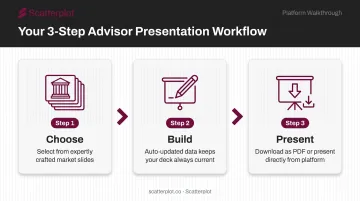
Founded by Sanjeev Pati, CFA, Scatterplot was built to solve exactly this problem. It provides a dynamic library of client-ready investment visuals and economic charts — automatically updated with the latest market data and fully branded with the advisor's logo, colors, and compliance disclosures. The workflow is designed to eliminate prep time without sacrificing professionalism:
- Choose from a library of expertly crafted slides, each built to make market concepts easy to explain
- Build your deck — slides are automatically updated as data changes, so the deck is always current
- Present by downloading as a PDF or presenting directly from the platform
Each slide includes guided talking points, so advisors walk into every meeting knowing exactly how to frame the data for their client — not just what the chart shows, but how to make it meaningful.
At $99/month with a 7-day free trial, Scatterplot is accessible to solo RIAs and wealth management teams alike. The branding setup — logo, colors, disclosures — is configured once and applies consistently across every deck.
| Feature | Details |
|---|---|
| Key Features | Automatically updated market and economic charts, branded slide library, guided talking points, custom disclosures, PDF export or in-platform presentation |
| Pricing | $99/month; 7-day free trial; contact scatterplot.co for team/enterprise options |
| Best For | Wealth managers and RIAs who want professionally branded, data-current presentations without hours of prep work |
Tool 6: Tax Planning Software
Tax planning has become a meaningful differentiator. Clients increasingly expect their advisor to proactively surface tax opportunities — not just manage investments. For advisors who aren't CPAs, the challenge is having credible tax conversations without overstepping.
Primary option: Holistiplan
Holistiplan's OCR-based tax return scanning generates a full analysis in under two minutes. From there, advisors can model Roth conversion scenarios, charitable giving strategies, and bracket management — all presented in client-friendly language. It makes proactive tax planning accessible without requiring a tax law background.
| Feature | Details |
|---|---|
| Key Features | Tax return scanning (OCR), scenario analysis, Roth conversion modeling, charitable giving strategies, ACA planning |
| Pricing | Standard: ~$99/month; Premium and Premium+ tiers available with additional planning modules |
| Best For | Advisors offering holistic planning who want to add meaningful tax strategy to client conversations |
Tool 7: Estate Planning Software
Estate planning is a high-retention service area — clients who receive estate planning support are less likely to leave. Software now makes it possible for advisors to visualize estate flows, model strategies, and give clients a clear picture of where their assets go without requiring an attorney for every conversation.
Primary option: Vanilla
Vanilla visualizes asset flow through an estate in a way clients can actually follow. Advisors can model advanced estate tax strategies, run estate health checks, and use the Document Builder to help clients create pour-over wills and revocable trusts as a starting point for attorney review.
| Feature | Details |
|---|---|
| Key Features | Estate plan visualization, scenario modeling, document creation, estate health check, client-facing summaries |
| Pricing | Available via demo; contact Vanilla directly for current pricing |
| Best For | Advisors serving HNW/UHNW clients or those expanding into total wealth advisory services |
Tool 8: Scheduling & Video Conferencing Tools
Scheduling and video tools are workflow infrastructure — often overlooked in tech stack discussions but responsible for eliminating friction from every client interaction. Back-and-forth booking emails and poor video quality both erode the professional experience advisors work hard to build.
Recommended tools:
- Scheduling: Calendly or Acuity Scheduling
- Video: Zoom or Microsoft Teams
Key features to prioritize:
- Calendar integration and time zone support
- Automated meeting reminders (reduces no-shows)
- Screen sharing and meeting recording
- AI transcription for meeting notes
- End-to-end encryption for sensitive discussions
| Feature | Details |
|---|---|
| Key Features | Online booking, calendar sync, automated reminders; screen share, recording, AI transcription, E2E encryption |
| Pricing | Calendly: free to ~$16/user/month; Zoom: ~$15–$20/user/month; Microsoft Teams: included in M365 plans |
| Best For | Any advisory firm; especially critical for practices with remote or geographically dispersed clients |
Tool 9: Document Management & Client Data Tools
Two complementary functions belong in this category: secure cloud document storage and structured client data gathering. Together, they cover the full document lifecycle — from onboarding intake through long-term record retention.
Recommended tools: Dropbox Business (storage), PreciseFP (client data and onboarding)
PreciseFP handles customizable digital intake forms that pull client data directly into the advisor's workflow — reducing manual re-entry and accelerating onboarding. Dropbox Business provides encrypted storage with audit trails and version control. Both address compliance obligations under SEC Rule 204-2, which requires investment advisers to maintain specified books and records.
| Feature | Details |
|---|---|
| Key Features | Encrypted file storage, audit trails, version control, e-signatures, CRM integrations, customizable intake forms |
| Pricing | Dropbox Business: ~$20–$26/user/month; PreciseFP: ~$29–$79/month depending on tier |
| Best For | Compliance-focused practices; firms modernizing and streamlining their client onboarding process |
Tool 10: Marketing & Client Communication Tools
Consistent communication between meetings is one of the clearest drivers of client retention. According to research highlighted by Nasdaq, improved client communication frequency is directly linked to advisor growth and client confidence — yet many advisors communicate sporadically, leaving clients feeling underserved between annual reviews.
Recommended tools: Constant Contact or Mailchimp (email); Hootsuite or Buffer (social media)
Key features that matter for advisory practices:
- Audience segmentation by client tier or life stage
- Automated email sequences for prospects and new clients
- A/B testing for subject lines and content
- Multi-platform social scheduling
- Engagement analytics to track what resonates
| Feature | Details |
|---|---|
| Key Features | Email segmentation, automation sequences, social post scheduling, A/B testing, engagement analytics |
| Pricing | Constant Contact: ~$12–$80/month; Hootsuite: ~$99–$249/month (Standard to Advanced) |
| Best For | Advisors building or scaling digital marketing; firms with active prospect pipelines |
How to Choose Financial Advisor Tools for Your Practice
Common Mistakes to Avoid
Most advisors make the same selection errors:
- Choosing tools based on brand recognition rather than workflow fit
- Selecting platforms that don't integrate with each other, creating data silos and manual workarounds
- Over-investing in feature-rich tools they'll only use at 20% capacity
A Practical Evaluation Framework
Before committing to any tool, run it through five questions:
- Integration — does it connect cleanly with your existing stack, or does it create a new silo?
- Security — does it meet SEC and state-level requirements for client data protection?
- Ease of use — will you and your clients actually use it consistently, or will it sit idle?
- Scalability — will it still serve you in two years, or will you outgrow it quickly?
- ROI — can you measure its value in hours saved, better client outcomes, or revenue retained?
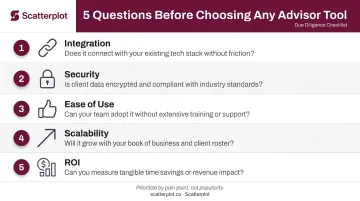
Once you've run a shortlist through these questions, prioritize by pain point — not by what's popular. If client prep time is the bottleneck, start with planning software and presentation tools. If onboarding is slow, document management and scheduling solve more immediate problems. Add tools in sequence, and each one will compound the value of the next.
Conclusion
In 2026, the advisors who grow are those who combine genuine expertise with tools that eliminate low-value work. Every hour recovered from data gathering, deck building, or administrative follow-up is an hour that goes back into client conversations — where revenue and retention are actually built.
One upgrade worth particular attention: the quality of communication during client meetings. Advisors who show up with professionally designed, current, and branded market visuals consistently report more confident conversations — clients understand the context, feel informed, and leave with greater trust in their advisor's command of the markets.
That's where Scatterplot fits in. With automatically updated investment charts, a fully branded slide library, and guided talking points built into every slide, it removes hours of prep from the advisor's calendar without sacrificing presentation quality. At $99/month with a 7-day free trial, the ROI case is straightforward: swap one hour of manual deck prep per week for a tool that handles it automatically.
Visit scatterplot.co to explore the slide library and start your free trial — or reach out at support@scatterplot.co to see how branded market visuals can sharpen your next client review.
Disclaimer
The content on this site is for informational and educational purposes only and does not constitute financial, investment, legal, or tax advice. It should not be relied upon as the basis for any investment decision. Past performance is not indicative of future results. Always consult a qualified financial professional before making any financial decisions.
Frequently Asked Questions
What technology do most financial advisors use?
CRM software, financial planning tools, and portfolio management platforms are the most widely adopted categories. The 2025 T3/Inside Information Software Survey found CRM and financial planning software consistently ranking as the highest-adoption categories among independent advisors.
How much should a financial advisor spend on technology tools?
Tech budgets vary by firm size and AUM, but ROI matters more than the dollar figure — think hours saved, client outcomes, and retention. A solo RIA might spend $500–$1,500/month across a full stack; larger practices spend more, and typically recoup costs through efficiency gains.
What is the best CRM for financial advisors?
Wealthbox, Redtail, and Salesforce Financial Services Cloud are the most widely used. Wealthbox and Redtail suit solo RIAs and small teams well; Salesforce FSC is better suited for enterprise advisory organizations with complex workflows and large teams.
How can financial advisors use AI tools in their practice?
Current applications include meeting transcription, OCR-based tax return scanning (Holistiplan), AI-assisted email drafting, and automated portfolio commentary — with platforms like Nitrogen and Orion now embedding AI meeting notes directly into advisor workflows.
What is the most important financial advisor tool for client retention?
Communication tools have the strongest link to retention. Financial planning software with client portals, performance reporting platforms, and client presentation tools give clients ongoing visibility and confidence between annual reviews.
How do I build a financial advisor tech stack from scratch?
Start with three foundational layers: a CRM, financial planning software, and a portfolio management/reporting tool. Once those are stable, layer in specialized tools for tax planning, estate planning, scheduling, client presentation, and marketing as your practice needs grow.