Choosing the wrong platform isn't just a minor inconvenience. Fragmented workflows, compliance gaps, and wasted adviser hours all compound over time — eroding the operational efficiency that software was supposed to deliver in the first place.
This guide cuts through the noise. It evaluates the top wealth management software platforms in 2026 based on functionality, integration depth, ideal use case, and pricing structure — so advisers and firms can make a confident, informed decision rather than an expensive one.
Key Takeaways
- Top platforms integrate portfolio management, financial planning, data aggregation, and client reporting in one system built for advisers and RIAs.
- Standout platforms in 2026 differentiate on AI-driven automation, custodian integration depth, and scalable infrastructure.
- Selection should match firm type, client complexity, and total cost of ownership — not just feature breadth.
- Top platforms covered: Orion Advisor Solutions, Addepar, SS&C Black Diamond, eMoney Advisor, and Envestnet.
- No platform covers everything; tools like Scatterplot address the client presentation gap most platforms leave unfilled.
What Is Wealth Management Software?
Wealth management software refers to integrated technology platforms that let financial advisers and RIAs manage client portfolios, run financial plans, aggregate account data, generate performance reports, and handle compliance tasks — all from a single system.
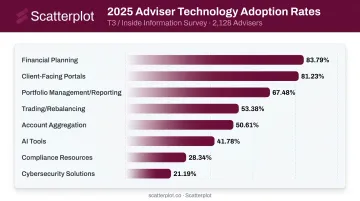
The 2025 T3/Inside Information Software Survey — based on 2,128 adviser responses — maps out exactly how advisers use these tools today:
| Software Category | 2025 Adviser Adoption |
|---|---|
| Financial planning software | 83.79% |
| Client-facing portals | 81.23% |
| Portfolio management/reporting | 67.48% |
| Trading/rebalancing | 53.38% |
| Account aggregation | 50.61% |
| AI for search and generative language | 41.78% |
| Compliance resources | 28.34% |
| Cybersecurity solutions | 21.19% |
Four functional categories define most platforms:
- Portfolio management and rebalancing — trade execution, performance tracking, and automated rebalancing
- Financial planning and goal modeling — cash flow projections, retirement scenarios, and goal-based advice
- Data aggregation — pulling account data from multiple custodians into one clean view
- Client reporting and engagement — performance reports, client portals, and communication tools
Some platforms cover all four. Others specialize in one or two. Knowing which category matters most for your practice is the fastest way to narrow the field.
Best Wealth Management Software Platforms in 2026
Platforms here were evaluated on breadth of features, integration ecosystem, scalability, pricing transparency, and track record with professional advisory firms — not marketing claims alone.
Orion Advisor Solutions
Orion is an end-to-end wealth management platform built for independent RIAs and enterprise advisory firms. It combines portfolio accounting, trading and rebalancing, financial planning integration, CRM, and business intelligence in a single ecosystem.
What sets it apart is scale and architecture. As of June 30, 2025, Orion reported $5.2 trillion in assets under administration, 7.5 million technology accounts, and 25,000 firms — including 17 of the top 20 Barron's RIA firms. The T3 survey confirmed Orion leads the portfolio management/reporting category with 16.54% market share and a 7.72 average rating.
Orion Denali AI is its enterprise intelligence layer, designed to unify data, workflows, and insights across CRM, planning, and risk workflows — one of the more substantive AI implementations in the market.
| Best For | Independent RIAs and mid-to-large advisory firms seeking an all-in-one platform with strong compliance and analytics |
| Key Features | Portfolio accounting, automated rebalancing, financial planning integration, CRM, business intelligence dashboards, compliance monitoring, Denali AI |
| Pricing Model | AUM-based or per-account pricing; contact Orion for enterprise rates |
Addepar
Addepar is a data aggregation and performance reporting platform built for high-net-worth and ultra-high-net-worth clients — with particular depth in portfolios containing alternative investments such as private equity, hedge funds, and real assets.
The platform surpassed $5 trillion in client assets in 2023, with client count more than doubling over the prior few years. T3 rated it 7.74 in portfolio management — nearly tied with Orion — despite its narrower 1.97% market share, a reflection of its concentration among complex, alternatives-heavy firms.
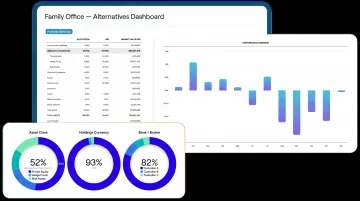
Addepar's Alts Data Management consolidates alternative investment data into one platform, removing the need for separate reconciliation workflows that plague multi-custodian family offices. For firms managing clients with diverse, hard-to-track assets, it solves a problem that most platforms handle poorly.
| Best For | Wealth firms, family offices, and RIAs managing complex or alternatives-heavy portfolios for HNW and UHNW clients |
| Key Features | Multi-custodian data aggregation, alternative investment tracking, performance attribution, scenario modeling, client portal, flexible API |
| Pricing Model | AUM-based pricing; contact Addepar for enterprise rates |
SS&C Black Diamond
SS&C Black Diamond is a portfolio management, performance reporting, and client relationship platform owned by SS&C Technologies. It serves 3,300+ firms, 968,000 active users, and $4.3 trillion+ in assets.
T3 ranks Black Diamond at 6.58% portfolio management market share with the highest average rating of the group at 7.94.
Its distinguishing feature is the exclusive integration with Morningstar's Direct Advisory Suite — the first and only wealth platform with direct access to this research suite. Combined with white-label client portal capabilities, it's a strong fit for advisory practices that need institutional-grade reporting and a polished client-facing experience.
| Best For | US-based RIAs and financial advisers needing robust performance reporting, Morningstar research integration, and branded client portals |
| Key Features | Portfolio accounting, performance reporting, trading and rebalancing, CRM tools, Morningstar Direct Advisory Suite integration, white-label client portal |
| Pricing Model | AUM-based pricing; contact SS&C for rates |
eMoney Advisor
eMoney Advisor is the most widely adopted financial planning platform in the US. The T3 survey gives it 28.20% market share in financial planning — a commanding lead — and an 8.22 average rating, the highest of any platform in its category. It also leads account aggregation with 19.55% market share.
More than 109,000 financial professionals use eMoney to serve 6 million+ households. Its collaborative client portal lets clients self-input financial data and view real-time plan updates, which eMoney's own research (a June 2023 study of 1,507 individuals) links to higher adviser satisfaction scores, stronger goal motivation, and more referrals.
One example: Waverly Advisors, an Austin, TX firm managing $310M AUM across 180 households, uses eMoney specifically for its collaborative planning capabilities.
| Best For | Financial planners and RIAs who prioritize comprehensive planning, goal-based advice delivery, and interactive client portals |
| Key Features | Cash flow and retirement planning, account aggregation, client portal with document sharing, spending and budgeting tools, business analytics, third-party integrations |
| Pricing Model | Per-adviser subscription; contact eMoney for current pricing tiers |
Envestnet
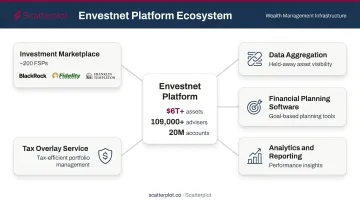
Envestnet operates as a Turnkey Asset Management Platform (TAMP), though its scope extends well beyond that label. It functions as a broad wealth management ecosystem connecting independent advisers and broker-dealers to investment products, financial planning software, data aggregation, and analytics.
The numbers reflect that scope: $6 trillion+ in platform assets, nearly 20 million accounts, and 109,000+ financial advisors as of March 2024. It supports 17 of the 20 largest US banks and 48 of the 50 largest wealth management firms. In 2024, Bain Capital completed a $4.5 billion take-private transaction — suggesting the platform's position in the wealth management stack is unlikely to shrink.
Its RIA Marketplace offers approximately 200 Fund Strategist Programs from managers including BlackRock, Fidelity, Franklin Templeton, and State Street — with no platform fee for those programs, since managers help offset costs. The Tax Overlay service monitors ongoing positions and models tax impacts of trades to optimize after-tax returns.
| Best For | Independent advisers, broker-dealers, and wealth firms seeking a broad ecosystem combining investment products, planning tools, and data aggregation |
| Key Features | TAMP investment marketplace (~200 FSPs), data aggregation including held-away assets, financial planning software, analytics and reporting, tax overlay, insurance solutions |
| Pricing Model | Per-adviser or AUM-based fees depending on product; contact Envestnet for details |
Key Features to Look for in Wealth Management Software
The T3 survey asked advisers to rank software categories by value — CRM ranked first (2.08 average), financial planning second (2.64), and portfolio management third (3.04). Use those priorities as your starting point, then evaluate each platform on the following criteria before committing:
Integration Depth
Custodian integration is where marketing claims most often outpace reality. Ask vendors specifically:
- How many live, production-tested custodian connections exist (not claimed partnerships)?
- Which workflows — rebalancing, reporting, onboarding — are fully automated vs. still requiring manual steps?
- How does the platform handle data normalization when multiple custodians use different data formats?
T3 described the fintech landscape as "overwhelming" and stressed that tighter integrations are critical for all-in-one claims to hold up in practice.
AI Readiness
41.78% of surveyed advisers now use AI tools — making AI capability a present-day evaluation criterion. When assessing AI capabilities:
- Ask vendors to demonstrate AI features in a live production environment, not a curated demo
- Distinguish between platforms with verified AI infrastructure (Orion's Denali AI is a documented example) and those using "AI" as a marketing label
- Look for specific applications: data anomaly detection, workflow automation, and intelligent client insights — not just chatbots
Compliance and Security Infrastructure
Only 28.34% of advisers use compliance resources and just 21.19% have adopted cybersecurity solutions — a real liability gap now that SEC Regulation S-P amendments now require covered institutions to maintain written incident response programs. Before signing any contract:
- Request vendor compliance documentation (SOC 2 reports, audit trails, role-based access controls)
- Confirm regulatory reporting capabilities match your specific SEC/FINRA obligations
- Ask about data breach notification protocols and incident response timelines
Scalability
Evaluate pricing and infrastructure at the scale you plan to reach in 3–5 years — not your current AUM. Key questions to ask:
- Does per-AUM or per-account pricing become disproportionately expensive as you grow?
- What does a platform migration actually cost in time, data conversion fees, and operational disruption?
Platforms that look affordable today can lock you into structures that penalize growth. Build your exit criteria before you sign.
How We Chose the Best Wealth Management Software Platforms
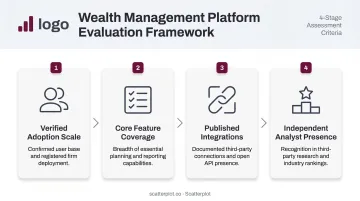
Platforms were selected based on four criteria:
- Verified adoption scale — adviser adoption rates and firm counts drawn from T3 survey data and official vendor disclosures
- Core feature coverage — breadth across the categories advisers actually use: planning, reporting, aggregation, and client portal
- Published integrations — confirmed custodian and third-party connections, not vendor-claimed ones
- Independent analyst presence — inclusion in T3 rankings, industry publications, and verified press sources
This list targets platforms serving professional advisory firms — RIAs, financial planners, and wealth managers. Direct-to-consumer robo-advisors and institutional core banking systems serve fundamentally different use cases and aren't included.
Those criteria also reflect where advisers most commonly go wrong during platform selection:
- Prioritizing UI appeal over integration reliability
- Selecting based on a single standout feature — a polished client portal, for instance — while creating workflow fragmentation elsewhere
- Underestimating total cost of ownership: subscription fees are just the starting point; implementation, data migration, and ongoing support costs are significant
Conclusion
The best wealth management software platform isn't the one with the longest feature list. It's the one that fits your firm's specific client base, operational complexity, and growth trajectory. A mismatch creates exactly the fragmentation you were trying to eliminate.
Before committing, run structured pilots with your shortlisted vendors. Test integrations under realistic conditions — not polished demos. And evaluate performance at the scale you'll reach in three to five years, not where you are today.
One gap worth factoring into that evaluation: client communication. Portfolio accounting and financial planning tools handle the operational side well, but building the actual presentation materials — current market charts, economic visuals, talking points for client meetings — still falls on the adviser.
Scatterplot fills that gap. Founded by Sanjeev Pati, CFA, the platform delivers daily-updated, fully branded market visuals and guided talking points so advisers spend less time building slides and more time in front of clients. At $99/month with a 7-day free trial, it sits alongside any platform in this guide rather than replacing one.
Disclaimer
The content on this site is for informational and educational purposes only and does not constitute financial, investment, legal, or tax advice. It should not be relied upon as the basis for any investment decision. Past performance is not indicative of future results. Always consult a qualified financial professional before making any financial decisions.
Frequently Asked Questions
What are the top wealth management technology platforms?
Leading platforms include Orion Advisor Solutions, Addepar, SS&C Black Diamond, eMoney Advisor, and Envestnet. The right choice depends on firm size, client complexity, and whether the primary need is portfolio management, financial planning, or data aggregation — each platform has meaningful gaps in at least one of those areas.
What is the difference between financial planning software and portfolio management software?
Financial planning software (such as eMoney) models goals, cash flows, and retirement scenarios. Portfolio management software (such as Black Diamond or Addepar) handles trade execution, rebalancing, performance reporting, and custodian data. Many modern platforms now combine both functions, though depth varies significantly.
How much does wealth management software typically cost?
Most platforms use AUM-based fees, per-adviser subscriptions, or enterprise licensing — and none of the major platforms publish standard price schedules publicly. Factor in implementation, data migration, and ongoing support costs beyond the headline subscription, as these often exceed the annual software fee in year one.
What features should RIAs prioritize when choosing wealth management software?
Prioritize the capabilities that affect daily operations and are hardest to add later:
- Custodian integration depth
- Automated rebalancing and reporting
- Compliance audit trail functionality
- Scalable pricing as AUM grows
- Quality of the client-facing portal
Is wealth management software suitable for solo financial advisers?
Yes — eMoney and Orion both offer options accessible to solo advisers. Weigh feature breadth against cost carefully. Without an internal IT team, streamlined onboarding and responsive vendor support matter more than they would at a larger firm.
How does AI improve wealth management software platforms?
Verified AI capabilities in leading platforms include data unification across workflows (Orion Denali AI), automated anomaly detection, and intelligent client insights. Ask vendors to demonstrate AI features in live production environments — the gap between demo capability and production-ready functionality is wider than most sales presentations suggest.