Introduction
AI has moved from conference talking point to daily workflow reality for investment professionals. The pace has accelerated sharply — what felt experimental two years ago is now embedded in analyst research workflows, adviser meeting prep, and compliance monitoring.
The challenge isn't finding AI tools. There are hundreds of them. The challenge is knowing which applications create genuine value versus which ones generate impressive-looking outputs that don't actually improve decisions or client outcomes.
This article breaks down what AI is doing in investment management right now, where it produces measurable results across the investment lifecycle, and how advisers and wealth managers can build a practical strategy around it — with specific examples, not just frameworks.
Key Takeaways
- McKinsey estimates AI could deliver impact worth 25%–40% of an asset manager's cost base
- Formal AI/ML adoption in fund strategies remains minimal — but behind-the-scenes productivity use is already widespread
- The biggest near-term wins for advisers are in research synthesis, meeting prep, and client communication
- AI works best as an augmentation layer: human judgment, fiduciary responsibility, and contrarian thinking remain firmly in adviser hands
- Independent advisers and RIAs can access capable AI tools without enterprise IT infrastructure
What AI Actually Does in Investment Management Today
Traditional AI vs. Generative AI — Why the Distinction Matters
Investment management has used traditional machine learning for years: pattern recognition in price data, quantitative factor models, algorithmic execution, fraud detection. These are narrow, well-defined applications with measurable outputs.
Generative AI and agentic AI represent a different category. They can synthesize unstructured information, produce written content, and — increasingly — take autonomous action across multi-step workflows.
That distinction matters because investment management generates enormous volumes of unstructured data: earnings call transcripts, regulatory filings, analyst reports, news, conference commentary. Processing that data at scale is where the genuinely transformative value sits.
The Adoption Reality
The data tells a more complicated story than most coverage lets on:
- Formal strategy adoption is minimal: ESMA (2025) found only 145 funds explicitly indicating AI/ML use in investment strategies from a sample of approximately 44,000 EU funds — roughly 0.1% of UCITS assets under management
- Behind-the-scenes use is widespread: The CFA Institute's 2024 survey of 300 CIOs, portfolio managers, and CFOs found AI was the single most-raised issue — not as a future concern, but a present operational reality
- The efficiency opportunity is large: McKinsey estimates AI, generative AI, and agentic AI could produce impact equivalent to 25%–40% of an asset manager's cost base, with function-level estimates of 8% for investment management and 5% for risk and compliance
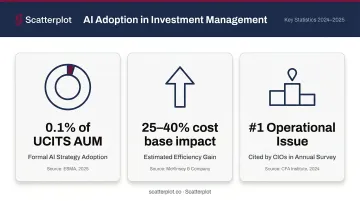
The gap between low formal adoption and high informal use tells its own story: AI is already embedded in how investment professionals work, even when it's not embedded in official fund strategies.
Key Applications Across the Investment Lifecycle
Portfolio Management and Research
The most immediate application for investment analysts is research synthesis. Where reading through fifty earnings call transcripts once took days, LLM-based tools can extract themes, flag sentiment shifts, and surface relevant passages in minutes. McKinsey's 2025 research confirms analysts are using generative AI assistants to synthesize earnings calls, financial reports, and conference transcripts as a standard workflow.
That workflow has academic backing. AllianceBernstein's research published in the Journal of Investment Management applied text-mining techniques to earnings call transcripts from 2010 to 2021, demonstrating that document attributes, readability, and management sentiment contain genuine signal.
AI also supports thematic investing in a practical way: tools can scan thousands of securities and identify direct and indirect exposure to a specific theme faster than any manual process, with the analyst applying judgment to refine and validate outputs.
A note on model selection: BloombergGPT, a 50-billion parameter finance-trained model, outperforms general models on financial NLP tasks. However, a 2023 paper in Machine Learning with Applications found ChatGPT delivered approximately 35% better performance than the domain-specific FinBERT on financial sentiment analysis. Run task-specific evaluations before committing to any model. Domain specialization doesn't guarantee better results for every use case.
Risk Management and Compliance
AI's compliance applications are less publicized but often more immediately valuable for advisory firms:
- Automated monitoring of regulatory documents for updates and changes
- Anomaly detection in transaction data and portfolio exposures
- Gap analysis against documentation requirements
- Generation of audit-ready reports without manual assembly
McKinsey's function-level estimates put the AI efficiency impact for risk and compliance at 5% — modest relative to other functions, but in a cost center where manual processes are embedded, that's meaningful.
FINRA's published guidance on AI use in securities firms confirms that member firms are already exploring AI tools to digitize, review, and interpret regulatory intelligence. The use case is real; the governance around it is still developing.
Client Engagement and Communication
This is where generative AI delivers the most visible productivity gains for advisers. The core applications:
- Personalized portfolio summaries — tailored to individual client holdings and concerns, not generic market recaps
- Meeting preparation — pre-meeting briefs that surface relevant client life events, portfolio changes, and conversation starters
- Post-meeting follow-up — automated notes and email drafts generated from meeting recordings (with client consent)
Morgan Stanley's 2024 launch of AI @ Morgan Stanley Debrief — an OpenAI-powered tool that generates structured notes from client meetings, integrates with CRM systems, and drafts follow-up emails — is the clearest large-scale example of this in practice.

Accenture's 2025 survey of 500 North American financial advisers found that 96% believe generative AI can transform client servicing and investment management, with 50% identifying personalized product recommendations as a high-value application. These aren't theoretical positions — advisers see where the time savings are.
AI Tools Wealth Managers and Financial Advisers Are Using Today
Tool Categories That Matter for Advisers
The adviser technology landscape has three practical AI categories:
| Category | What It Does | Best For |
|---|---|---|
| Research synthesis | LLM-based scanning of reports, filings, and news | Analysts, portfolio managers |
| Portfolio analytics | AI-driven scenario modeling, risk attribution, factor exposure | PMs, compliance teams |
| Client communication | Automated or AI-assisted content creation and presentation | All advisers |
The Productivity Case
The productivity evidence is consistent across contexts. Morgan Stanley CEO Ted Pick stated AI could save financial advisers 10–15 hours per week. BCG and Harvard Business School's 2023 study of 758 consultants found those using GPT-4 completed 12.2% more tasks, worked 25.1% faster, and produced 40% higher-quality outputs — with the largest gains going to less experienced professionals.
Neither finding is exclusively investment-management data, but for advisers the implication is direct: the hours spent on preparation work are where AI delivers fastest.
For advisers specifically, the time savings concentrate in preparation work: sourcing data, building charts, assembling decks, and writing client-facing commentary. These tasks are essential to client relationships but don't require the adviser's judgment in the same way that a portfolio recommendation or financial plan does.
Where Scatterplot Fits
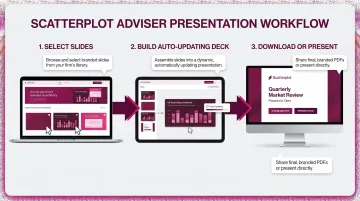
Platforms that handle the visual and presentation layer automatically put this time saving into practice. Scatterplot gives wealth managers a daily-updated library of branded investment charts and market insight slides covering markets and the economy, with guided talking points included alongside each slide. Advisers set their logo, brand colors, and compliance disclosures once — every slide in the library reflects that branding automatically.
The workflow runs in three steps:
- Choose slides from the library
- Build a deck that updates automatically
- Download as a PDF or present directly from the platform
At $99/month with a 7-day free trial, it's accessible to independent RIAs and smaller practices with no IT setup or data integration required.
Targeted solutions that address a specific friction point — in this case, the hours advisers spend sourcing data and building decks — tend to deliver faster, more measurable returns than broad AI platform adoptions.
Enterprise vs. Accessible Tools
Large asset managers building proprietary models have different needs: custom data pipelines, internal model governance, specialized infrastructure. Most independent advisers and RIAs don't need any of that. SaaS-based AI tools (covering research synthesis, client communication, and presentation prep) are available today, require no IT investment, and can be evaluated within days.
How to Build an AI Strategy for Your Practice
Choosing which AI tools to adopt is only half the challenge. How you integrate them determines whether they change the work or just add another subscription to your stack. These principles separate productive adoption from expensive experimentation:
1. Start with friction, not features Identify where time is currently lost — research synthesis, meeting prep, client reporting, compliance review — and find tools that address those specific points. Technology adopted without a clear use case rarely sticks.
2. Focus on two or three core workflows AI delivers more value embedded in end-to-end workflows than used as isolated standalone tools. Pick the two or three client-facing or operational workflows with the highest friction, then build AI into those specifically. Broad adoption without focus produces narrow results.
3. Buy, don't build For independent advisers and most wealth managers, building or customizing AI models internally is neither practical nor necessary. Third-party tools are the right starting point. When evaluating options, prioritize:
- Output quality and consistency across real use cases
- Data governance and compliance track record
- Fit with existing workflows — not the sophistication of the underlying model
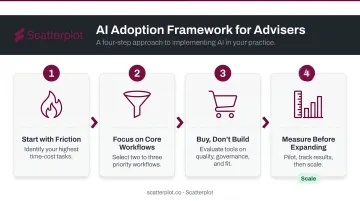
4. Measure before expanding Pilot one or two tools, track time savings and output quality explicitly, then expand from what works. The trap is adopting tools broadly before understanding which ones actually change the work.
Risks, Limitations, and Keeping Human Judgment Central
Cognitive Overreliance
Microsoft Research's 2025 survey of 319 knowledge workers found higher confidence in generative AI was directly associated with less critical thinking effort. For investment professionals, this is a specific risk: contrarian thinking, probabilistic reasoning, and independent judgment are central to generating alpha.
The BCG/HBS study found that consultants using AI outside the tool's capability boundary were 19 percentage points less likely to produce correct answers than those not using AI at all. When automation fails in this context, the errors are often harder to catch precisely because the model's output looks credible.
Bias and Opacity
Current AI models, including LLMs, exhibit measurable biases and cannot fully explain how they arrive at outputs. The Financial Stability Board's 2024 report identifies explainability and opacity as specific financial-stability vulnerabilities, alongside model risk, data quality, and third-party concentration.
In a fiduciary context, "the model said so" is not a defensible answer. Explainable AI frameworks are improving, but they aren't mature enough to eliminate the need for human review.
The Regulatory Environment
That gap in explainability is part of why regulators are moving carefully. Formal AI-specific rules for investment advisers are still developing:
- FINRA (2024) reminds member firms that existing obligations — supervision, communications, books and records, customer information protection — apply to generative AI use without modification
- SEC (2023) proposed rules requiring broker-dealers and investment advisers to address conflicts of interest in predictive data analytics; no final rule has been issued
- FCA (2024) describes an outcomes-based, technology-agnostic approach rather than prescriptive AI-specific rules
In practice: benchmark against existing model risk management standards — the Federal Reserve's SR 11-7 framework remains the foundational reference — and establish internal governance before scaling AI across client-facing workflows.
Disclaimer
The content on this site is for informational and educational purposes only and does not constitute financial, investment, legal, or tax advice. It should not be relied upon as the basis for any investment decision. Past performance is not indicative of future results. Always consult a qualified financial professional before making any financial decisions.
Frequently Asked Questions
What is AI used for in investment management?
AI supports investment research and data synthesis, portfolio optimization, risk and compliance monitoring, and client communication. It functions primarily as a productivity and insight tool — accelerating analysis, automating preparation tasks, and surfacing relevant information — rather than as an autonomous decision-maker.
How is AI changing the role of financial advisers?
AI reduces the time advisers spend on manual data tasks, preparation, and report generation, freeing capacity for client relationships and complex planning. The adviser's judgment, empathy, and fiduciary responsibility remain central — none of that transfers to a machine.
What are the risks of using AI in investment management?
The primary risks include overreliance and skill erosion, model bias and limited explainability, data privacy exposure, and regulatory uncertainty. Each requires ongoing human oversight and internal governance — tool-level safeguards alone aren't enough.
Can smaller advisory firms benefit from AI tools?
Accessible, SaaS-based AI tools don't require large IT infrastructure. Independent advisers and RIAs can realize real time savings from off-the-shelf platforms for research synthesis, client reporting, and presentation preparation — at price points designed for individual practitioners.
What's the difference between traditional AI and generative AI in finance?
Traditional AI handles pattern recognition, quantitative predictions, and algorithmic trading. Generative AI creates content, synthesizes natural language, and works with unstructured data — earnings transcripts, news, filings. That capability is what's reshaping how wealth and asset managers communicate, research, and prepare client materials.
How should investment professionals start integrating AI into their practice?
Take a workflow-first approach: identify the highest-friction tasks, pilot one or two purpose-built tools, measure time savings and output quality, and scale the tools that deliver results. Broad adoption without clear use case definition wastes time and budget.