Introduction
Advisers spend hours every week doing work that has nothing to do with advising. Sourcing market data, rebuilding charts, polishing slide decks — these tasks consume time that should go toward client conversations, portfolio strategy, and business development.
The scale of this problem is real. Broadridge's 2024 advisor marketing research found that 85% of advisers say finding time for marketing and content is a challenge, with many spending fewer than two hours per week on client communication despite needing to do far more.
That assembly work — pulling live data, generating visuals, formatting branded slides — is exactly where AI-powered content automation is making a measurable difference. Advisers walk into meetings prepared rather than scrambling.
This article covers practical examples of content automation in investment services: automated market commentary, branded presentation decks, personalized portfolio summaries, compliance-aware content, and data visualization, plus what to look for when evaluating a solution.
Key Takeaways
- Advisers lose significant weekly hours to manual content prep — hours that AI automation can redirect to clients
- AI content tools pull live data, generate narratives, and enforce brand rules automatically — no templates to manually update
- Key use cases: market commentary, branded decks, portfolio summaries, compliance disclosures, and chart automation
- 30–40% advisor productivity gains are projected for wealth management from GenAI adoption
- Top platforms update daily, embed branding by default, and eliminate design work entirely
What Is AI-Powered Content Automation in Investment Services?
Content automation in investment services means technology that generates, formats, and distributes investment content — market commentary, client reports, branded slide decks — directly from live financial data, without manual assembly.
That's a meaningful distinction from traditional templates, which still require someone to download data, paste it in, update charts, and reformat slides — a process that takes hours and breaks the moment data changes.
Beyond Fill-in-the-Blank Templates
AI-powered automation works differently:
- Ingests live data feeds from markets, economic releases, and portfolio systems
- Generates contextual narratives that explain what the data means, not just what it shows
- Applies branding rules automatically — logo, colors, disclosures — across every output
- Updates content daily so advisers always have current materials ready to access
Scope of Content Covered
In investment services, automation spans two broad categories:
| Content Type | Examples |
|---|---|
| Client-facing materials | Presentation decks, portfolio summaries, market outlook slides |
| Internal/operational documents | Performance reports, compliance filings, meeting prep materials |
Platforms like Scatterplot focus on the client-facing side — delivering a library of daily-updated, fully branded investment visuals with guided talking points, so advisers can walk into client meetings prepared.
Why Investment Professionals Are Adopting Content Automation Now
Two forces are driving adoption: scale pressure and compliance risk.
The Volume Problem
Advisers serving dozens or hundreds of clients can't manually produce personalized, current content for each relationship. Monthly reporting cycles, quarterly reviews, and market-event communications all demand fresh materials on a repeating schedule. Manual processes simply don't scale.
The advisor sentiment data reflects how seriously this is taken. A 2025 InvestmentNews survey found 82% of advisers planned to invest in generative AI in coming years, up from 66% in 2024. That 16-point jump in a single year signals a shift from curiosity to operational urgency.
The Compliance Pressure
Investment communications carry regulatory weight. The SEC's Marketing Rule (Rule 206(4)-1) prohibits misleading statements and requires substantiation for material claims. The SEC has run enforcement sweeps resulting in charges against nine investment advisers in both 2023 and 2024, with combined penalties of $850,000 and $1.24 million respectively.
Across a team, manual content creation introduces inconsistency in disclosures, data sourcing, and language — exactly the gaps regulators look for. Automated systems that apply compliance rules to every output by default close those gaps before content reaches a client.
Key AI-Powered Content Automation Examples in Investment Services
Automated Market Commentary and Economic Reporting
Every week, advisers face the same task: summarize what happened in markets and explain what it means for clients. Done manually, that's two to four hours of writing, fact-checking, and formatting.
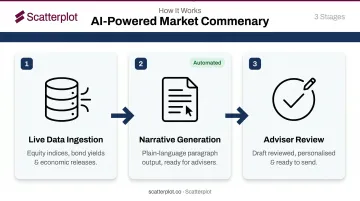
AI market commentary tools change this workflow:
- Live data ingestion — equity indices, bond yields, economic releases feed directly into the system
- Narrative generation — the tool produces plain-language paragraphs explaining market moves in client-appropriate terms
- Adviser review — the draft is ready to edit lightly or send as-is, rather than written from scratch
The productivity case is well-documented. McKinsey reported that one leading asset manager estimated 100,000 hours in annual savings from AI-driven query management and workflow automation. Oliver Wyman and Morgan Stanley projected 30–40% productivity gains for advisers in wealth and asset management from generative AI applied to report drafting and market research.
Timely commentary also keeps advisers present in clients' minds. An adviser who sends a clear market update after a volatile week becomes the trusted guide clients turn to first — not the last call they make.
Branded Client Presentation Decks
Building a client deck from scratch — pulling charts, updating data, matching colors, adding disclosures — easily takes two to three hours per meeting. AI deck automation collapses that to minutes.
How it works in practice:
- Pre-built slide templates come loaded with market and economic charts
- Brand elements (logo, colors, firm disclosures) are embedded across every slide by default
- Data refreshes automatically so charts reflect current market conditions without manual updates
- Guided talking points accompany each slide, giving advisers confident language to explain what they're showing
This is exactly what Scatterplot delivers. The platform maintains a daily-updated library of client-ready investment visuals, fully branded for each adviser's firm. Rather than spending hours in PowerPoint, advisers select slides from the library, add them to a deck, and download or present directly — with consistent design and current data every time.
That consistency matters at the firm level too. When every deck draws from the same source with the same data standards and disclosure language, there's no risk of one adviser presenting a chart built on a different date or a different methodology.
Personalized Portfolio Summaries and Performance Updates
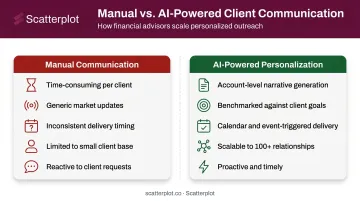
Generic market updates are table stakes. Clients increasingly expect communication tied to their specific holdings, goals, and performance — not a one-size email blast.
AI-driven personalization makes this feasible at scale:
- Account-level data feeds into a generation process that produces individual narratives
- Each summary contextualizes returns against benchmarks, client goals, and current conditions
- Advisers can trigger delivery by calendar events (quarter-end) or market events (significant drawdown)
The gap between client expectations and adviser delivery is measurable. Salesforce's 2025 financial services data found only 41% of wealth management clients were fully satisfied with their institutions' customer service speed and effectiveness. Personalized, timely communication directly addresses this gap.
For advisers managing 100+ client relationships, that's the practical value: genuine one-to-one communication at a scale that simply wasn't possible before.
Compliance-Ready Content and Disclosure Automation
Compliance in investment communications shouldn't be a final-step checklist. AI tools that embed it into the content generation process itself change the risk profile from the start.
Key capabilities to look for:
- Auto-insertion of required disclosures on every output by default
- Regulatory language libraries that reflect current rules
- Audit trails tracking what content was sent, when, and to whom
One clarification worth noting: platforms like Scatterplot support compliance by embedding firm-specific disclosures into every branded slide output. That's a meaningful infrastructure feature. Compliance review itself, however, remains the adviser's professional responsibility.
AI-Driven Data Visualization and Chart Generation
The chart-building step is where manual deck creation slows down most. Downloading data, opening Excel, formatting a chart, matching brand colors, copying into PowerPoint — that process alone can consume 30–45 minutes per deck.
Automated visualization tools remove the entire process:
- Charts are pre-built and pre-formatted to brand standards
- Data updates automatically based on market data provider schedules
- Advisers access a library of ready-to-use visuals rather than building from scratch
Scatterplot operates on this model. The platform's slide library covers markets and economic data, with charts updated on daily, weekly, monthly, or quarterly schedules based on underlying data release cadences. Advisers select from the library, preview slides, and add them to decks through a simple portal — no design tools or data downloads required.
Benefits of AI Content Automation for Wealth Advisers
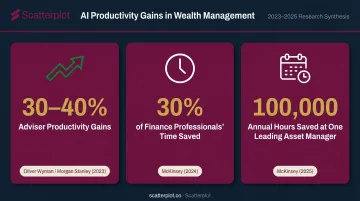
The productivity case is strong. Quantified estimates from credible sources tell a clear story:
- 30–40% advisor productivity gains projected for wealth and asset management (Oliver Wyman / Morgan Stanley, 2023)
- 30% of finance professionals' time saved by a GenAI assistant replacing manual number-crunching (McKinsey, 2024)
- 100,000 annual hours saved at one leading asset manager from AI-driven workflow automation (McKinsey, 2025)
The productivity gains matter, but so does what happens in the client relationship. J.D. Power's 2024 Full-Service Investor Satisfaction Study found that trust is the single most important satisfaction driver among advised clients — and that 41% of advised client experiences are transactional, making them vulnerable to lower-cost alternatives.
Advisers who deliver polished, timely, data-backed materials signal competence and reliability. That signal has a direct effect on retention. The same study found that 36% of affluent Millennials with over $1 million in investable assets said they were likely to switch firms within the next year. Content quality and communication consistency are part of what keeps those clients engaged.
How to Choose the Right AI Content Automation Solution
Not all platforms deliver equal value. Three criteria separate genuinely useful tools from ones that just look good in demos.
Data Freshness
An AI content tool is only as current as its data. Solutions that update daily, automatically refreshing charts based on market data release schedules, eliminate the risk of an adviser walking into a client meeting with a three-week-old chart. Ask vendors directly: how often does content update, and is that update automatic?
Branding and Compliance Embedded by Default
Branding and compliance language should live in the system, not be applied manually per deck. The best platforms embed logo, colors, and firm disclosures into every output as part of the core product, not as an afterthought requiring manual setup each time. Scatterplot's model, where customization is configured once and applied consistently across every deck, reflects this principle.
Ready to Present Without Design Work
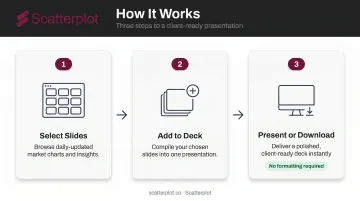
The adviser's job is advising, not designing. A solution that requires building charts, formatting slides, or adjusting data before it's client-ready has already lost part of the efficiency gain. Look for platforms where the workflow stays simple:
- Select the slides you need
- Add them to your deck
- Present or download — no formatting required
Guided talking points are a meaningful differentiator here. They help advisers explain visuals confidently without needing to independently research what each chart means.
Scatterplot's $99/month subscription (with a 7-day free trial) applies all three of these principles: daily-updated slides, branding configured once at setup, and guided talking points included by default — no design work required before a meeting.
Disclaimer
The content on this site is for informational and educational purposes only and does not constitute financial, investment, legal, or tax advice. It should not be relied upon as the basis for any investment decision. Past performance is not indicative of future results. Always consult a qualified financial professional before making any financial decisions.
Frequently Asked Questions
What is content automation?
Content automation uses technology to automatically generate, format, and distribute written and visual content from source data. In investment services, this means reports, slides, and market commentary produced from live financial data — without manual assembly by the adviser.
What are the four types of automation?
The four categories are rule-based automation, robotic process automation (RPA), cognitive/AI automation, and agentic automation. AI content automation for investment services falls under the latter two — systems that interpret data, generate language, and act on triggers without step-by-step human instruction.
How do financial advisers use AI for client presentations?
Advisers use AI-powered platforms to auto-generate branded slide decks populated with current market data, economic charts, and guided talking points. Instead of manually building charts and assembling decks before each meeting, they select from a pre-built, automatically updated library and present within minutes.
Is AI-generated investment content compliant with regulations?
Platforms that embed required disclosures and regulatory language into every output by design reduce compliance risk. However, advisers remain responsible for reviewing all materials and ensuring they meet their firm's specific regulatory requirements before distributing to clients.
How much time can AI content automation save wealth managers?
Oliver Wyman and Morgan Stanley project 30–40% productivity gains for advisers from generative AI applied to content and reporting workflows. For most advisers, that's multiple hours per week shifted from deck-building and report prep to direct client work.
What is the difference between AI content automation and traditional template tools?
Traditional templates require manual data entry, chart rebuilding, and static updates every time content changes. AI content automation pulls live data automatically, generates contextual narratives, applies branding rules, and refreshes on schedule — delivering a presentation-ready deck with no manual steps in between.