Introduction
Technical expertise gets advisors hired. Communication keeps them employed.
In wealth management, clients rarely leave because of a bad quarter. They leave because they felt uninformed, ignored, or like just another account number. According to YCharts' 2024 Advisor-Client Communication Survey, 75% of clients switched advisors or considered switching in 2023 — and communication quality was a central driver.
This guide covers the five most damaging communication failures advisors make, the psychological dynamics that turn small gaps into client exits, and the practical strategies — from visual tools to structured check-ins — that high-performing advisors use to defuse client anxiety before it turns into attrition.
Key Takeaways
- 75% of clients switched or considered switching advisors in 2023 — communication is the retention variable advisors control most directly
- Clients rank "deep understanding of my goals" above portfolio performance as a top satisfaction factor
- Proactive, personalized communication builds loyalty; reactive, jargon-heavy outreach drives clients away
- Visual market data reduces client confusion, builds credibility, and saves hours of prep time per meeting
- A scalable communication system is what separates consistently high-retention advisors from the rest
Why Client Communication Makes or Breaks Wealth Management Relationships
Most advisors believe performance is their primary retention lever. The data disagrees.
The YCharts 2024 survey of 775 advisory clients found that 56% cited "deep understanding of me and my goals" as a top satisfaction factor — edging out portfolio performance at 55%. Clients aren't evaluating advisors on spreadsheets. They're evaluating how seen and supported they feel.
The cost of getting this wrong runs in two directions:
- Direct attrition — clients who feel uninformed disengage quietly, then leave at the first competitive offer
- Referral erosion — 51% of clients chose their current advisor through a personal referral; advisors who communicate poorly lose not just clients but the pipeline those clients would have generated
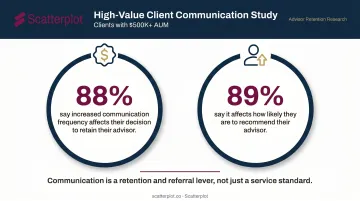
Among high-value clients (those with $500K+ under advisory), 88% said increased frequency or personalized communication would affect their decision to retain their advisor. Another 89% said it would affect how likely they are to recommend that advisor to others. Better communication doesn't just reduce churn — it actively builds the referral pipeline.
The Next-Gen Wealth Transfer Risk
That retention risk compounds when you factor in the generational wealth transfer already underway. Cerulli projects $124 trillion in wealth will transfer through 2048, with the vast majority going to heirs. Yet Cerulli's 2025 research found only 27% of expected inheritors would maintain their benefactor's advisor — dropping to 20% among those who already inherited.
Next-gen clients want digital access, proactive updates, and personalized engagement. Advisors who don't shift their communication approach to meet these expectations won't just lose one account — they'll lose the relationship with an entire family before it begins.
The Most Common Client Communication Challenges in Wealth Management
Challenge 1: Infrequent, Reactive Outreach
Many advisors reach out when clients call — or when markets crater. The problem: silence during calm periods creates anxiety that accumulates. When volatility hits, that anxiety turns into calls to liquidate.
The cadence benchmark from YCharts is clear: 79% of clients prefer contact at least every three months, and 47% of clients with $500K+ prefer monthly contact. Most advisors fall short of both thresholds.
Challenge 2: Jargon Overload
Alpha, beta, duration, Monte Carlo simulations — these terms are second nature to advisors and noise to most clients. Only 64% of typical advisor conversation content resonates with clients. Among rarely contacted clients, comprehension drops to 54%.
Jargon doesn't signal expertise — it signals that the advisor is speaking for themselves, not for the client.
Challenge 3: Digital Channel Mismatch
The Avaloq 2025 report on UK wealth management found 49% of clients now favor email and web-based channels — and client appetite for mobile and online access continues to grow. Advisors who default to phone-only outreach are meeting clients on their preferred channel less and less.
T3/Inside Information's 2024 survey of nearly 3,000 advisors found mobile messaging adoption jumped from 41.67% to 60.81% in a single year. Advisors who haven't made that shift are already behind a majority of their peers.
Challenge 4: Generic, One-Size-Fits-All Messaging
Sending the same market update to a 35-year-old accumulator and a 68-year-old retiree tells both clients the same thing: their advisor isn't paying attention. Generic messaging erodes perceived value — clients don't just feel underserved, they start questioning whether the relationship is worth the fee.
Challenge 5: Inability to Explain Market Events Clearly
When markets move sharply, clients want calm, clear context — fast. Advisors without ready-made materials often fall back on generic reassurance, or worse, go quiet while clients are watching their portfolios drop. Both responses leave clients feeling unguided. The advisors who retain trust in volatile periods are the ones who show up with something concrete to say.
How Client Psychology Amplifies Communication Breakdowns
Understanding why clients react the way they do changes how advisors should respond.
Loss Aversion
Tversky and Kahneman's prospect theory research established that financial losses feel roughly 2.25x more painful than equivalent gains feel good. This asymmetry means that during a market decline, the absence of advisor outreach doesn't register as neutral — it registers as neglect. Clients fill the information vacuum with fear.
Recency Bias and the 24/7 News Cycle
Clients watching financial news during a downturn don't naturally think in 20-year horizons. They anchor to what just happened. CFA Institute research documents how investors extrapolated recent market strength into permanent expectations during the 2003–2007 bull market — and made the same error in reverse during subsequent corrections. Without an advisor providing historical context, clients treat short-term volatility as a signal to act.
The Confidence Gap in Practice
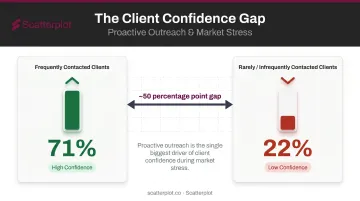
The communication-to-confidence link isn't theoretical. YCharts found a striking gap in how clients feel about their financial plans during potential recessions:
- 71% of frequently contacted clients felt very comfortable with their financial plan
- 22% of rarely or infrequently contacted clients felt the same
That difference — nearly 50 percentage points — separates a client who stays invested from one who calls to liquidate. Behavioral biases don't disappear, but proactive outreach interrupts the anxiety cycle before it escalates into a redemption call.
Proven Strategies to Overcome Client Communication Challenges
Establish a Proactive Communication Cadence
The advisors clients trust most don't wait to be called. They build a communication schedule and stick to it:
- Monthly — market commentary or brief economic update (prioritize $500K+ households)
- Quarterly — formal portfolio review with goals check-in
- Event-driven — immediate outreach within 24 hours of significant market moves
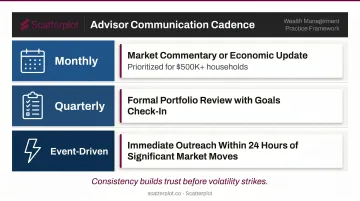
Consistency matters more than frequency. A client who hears from their advisor every month in calm markets won't panic when volatility hits — they already trust the relationship.
Segment Clients and Personalize Messaging
CRM segmentation is the infrastructure behind meaningful personalization. At minimum, segment by:
- Asset level (determines outreach frequency)
- Risk tolerance (shapes how market events are framed)
- Life stage (retirement-focused vs. accumulation-focused clients need different narratives)
- Anxiety level (some clients need more touchpoints during stress; CRM notes capture this)
Even small adjustments — referencing a client's specific retirement timeline in a market update — sharpen message relevance and strengthen client confidence in the relationship.
Lead with Empathy Before Data
When markets drop, clients don't want to hear about standard deviation. They want to know their advisor is aware of what's happening and thinking about them specifically.
The sequencing principle: acknowledge the concern first, then provide context. Opening a call with "I know the last week has been unsettling — let's talk through what this means for your plan" earns the client's attention before any data is presented. Leading with a chart, by contrast, risks losing them emotionally before the conversation gets started.
Simplify Without Dumbing Down
Practical techniques for translating complex concepts:
- Use analogies tied to experiences clients already understand
- Anchor abstract metrics to personal goals — "this volatility doesn't change your ability to retire at 65" is more useful than "your Sharpe ratio remains intact"
- Replace technical terms with plain equivalents on first pass; offer the technical term only if the client asks
When clients understand what's happening, they're far more likely to stay the course. Comprehension is a retention strategy.
Follow Up with Substance
Post-meeting follow-ups are underused and surprisingly high-impact. A brief written recap with a relevant chart or two signals attentiveness and gives clients something concrete to refer back to. Sourcing those visuals used to mean hours of manual work — platforms like Scatterplot solve that by delivering daily-updated, branded charts advisors can drop directly into follow-up decks. Advisors who follow up consistently earn more referrals and stronger client loyalty over time.
Why Visual Market Data Is a Game-Changer for Client Conversations
Why Visual Market Data Changes What Clients Hear — and Remember
Advisors often have the right insight and the wrong format for it. A verbal explanation of historical market recoveries during a downturn is fine. Showing a client a chart of every major correction and subsequent recovery, with their portfolio context alongside it, is different — the data argues more persuasively than words alone.
Research cited by Kitces found that visual formats — metaphors, roadmaps, charts — outperformed text-based bullet lists for attention, agreement, and retention. Presenters using visualizations were also perceived as more professional, better prepared, and more persuasive. In a wealth management context, that perceived credibility matters enormously during moments of client stress.
The bottleneck for most advisors isn't access to data — it's time. Kitces' productivity research found lead advisors spend 5.3 hours per week on meeting prep and another 6.6 hours on analytical work. Building charts from scratch, sourcing current data, and formatting branded decks is a significant portion of that time — time that could be spent on actual client relationships.
Where Scatterplot Fits
Scatterplot — built by CFA Sanjeev Pati specifically to address this prep burden — gives advisors a library of daily-updated, client-ready investment charts and market slides, automatically branded with their firm's logo, colors, and disclosures. Each slide comes with guided talking points, so advisors can walk into any client meeting — or fire off a post-meeting follow-up — without hours of manual prep.
Advisors can present slides directly from the platform or download them as PDFs for email distribution, portal uploads, or printed leave-behinds. Multiple branded decks can be created and managed simultaneously, all updating automatically as new data comes in.
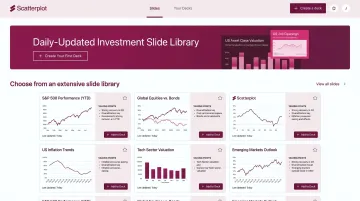
At $99/month with a 7-day free trial, the platform addresses one of the most consistent friction points in advisor communication: having the right visual content, on-brand and current, without building it yourself every time.
Building a Scalable, Consistent Communication Workflow
Ad hoc communication is inconsistent by design. Advisors who reach out only when something prompts them will inevitably go quiet at the wrong moments — exactly when clients need contact most.
Sustainable communication quality requires systems:
- Templated monthly updates — pre-structured content that requires only light customization per send
- Schedule quarterly reviews in advance, not reactively after the fact
- Onboarding sequences that walk new clients through what to expect from day one
- A volatility protocol that triggers outreach automatically when markets move past a defined threshold
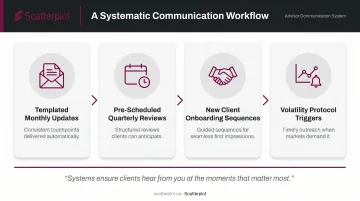
Technology reduces the friction of executing these workflows. T3/Inside Information's 2024 survey found 92.6% CRM penetration among advisors and 82.4% client portal adoption — up from 76.4% the year prior. Mobile messaging use jumped from 41.7% to 60.8% in a single year. Most advisors already have the tools to run a structured communication program.
What many advisors still lack is ready-made content to populate those workflows. CRM segmentation tells you who to contact. A communication calendar tells you when. But advisors still need quality materials — clear, branded, current visuals — to make each touchpoint meaningful rather than just frequent.
The compounding benefit: clients who feel consistently informed become natural referral sources. With 51% of clients choosing their advisor through a personal referral, a communication system that builds trust month over month doesn't just retain clients — it grows the practice.
Disclaimer
The content on this site is for informational and educational purposes only and does not constitute financial, investment, legal, or tax advice. It should not be relied upon as the basis for any investment decision. Past performance is not indicative of future results. Always consult a qualified financial professional before making any financial decisions.
Frequently Asked Questions
What are the most common communication mistakes wealth managers make?
The most damaging patterns are infrequent outreach, defaulting to jargon clients don't understand, sending generic updates that ignore individual goals, and being reactive rather than proactive. Any one of these erodes trust; most advisors struggling with retention are doing several simultaneously.
How often should wealth managers communicate with clients?
Quarterly contact is the minimum — 79% of clients expect it. Clients with $500K+ under advisory typically prefer monthly outreach. Layer in immediate communication during significant market events, regardless of where a client falls in your segmentation.
How should advisors communicate with clients during market downturns?
Lead with empathy and acknowledgment before presenting any data. Pair verbal reassurance with visual context: a historical recovery chart does more than any verbal explanation. Avoid predictions and refocus the conversation on the long-term plan, not short-term positioning.
How can advisors explain complex investment strategies without losing clients?
Use plain-language analogies, skip the jargon on first pass, and connect every concept to what the client actually cares about — their retirement date, their children's education, their income needs. The mechanism matters less to most clients than the outcome.
What role do visuals play in client communication for wealth managers?
Well-designed charts reduce the mental effort required to process complex market dynamics, improve comprehension, and strengthen advisor credibility — particularly during volatile periods when clarity and calm matter most. Clients retain visual information more effectively than verbal summaries alone.
How does poor communication affect client retention in wealth management?
Poor communication — not poor performance — is the primary driver of client exits. Clients who feel uninformed grow more sensitive to fees, more susceptible to competitor outreach, and less likely to refer others. Research consistently shows that communication frequency and personalization directly shape both retention and referral rates.