Introduction
Every week, wealth managers and financial advisers face the same grind: pulling market data from multiple sources, rebuilding charts that shifted with the markets, updating slide language to reflect current conditions, and polishing decks before client meetings — then doing it all again the following week.
This cycle is expensive. Kitces Research found that the average lead adviser spends 5.3 hours per week on meeting preparation and 4.2 hours on administrative tasks — time that compounds quickly across a full client book.
Content automation addresses that drain directly. It's the use of technology to automatically generate, update, and distribute market-related materials — charts, commentary, branded slides, talking points — without requiring manual effort each cycle.
This guide breaks down how it works, what it actually saves, and what to evaluate before adopting it.
Key Takeaways
- Content automation connects live data feeds to pre-built templates, producing client-ready materials on a recurring schedule
- Eliminates the weekly rebuild cycle for market charts, commentary, and client decks
- Brand rules (logo, colors, disclosures) apply automatically to every slide, keeping output consistent
- Primary use cases: client meeting decks, market updates, onboarding materials, and performance review context
- Automation handles the production; the adviser still drives the conversation
What Is Content Automation in Investment Services?
Content automation in the investment context is a system where data inputs — market prices, economic indicators, portfolio metrics — automatically trigger the generation, formatting, and delivery of client-facing materials without the adviser rebuilding them each cycle.
What "Content" Actually Means Here
In advisory practice, "content" is broader than most people assume. It includes:
- Market update slides with current index performance and economic context
- Branded presentation decks used in client meetings
- Chart packages covering equity markets, interest rates, and sector data
- Talking points tied to specific visuals
- Fact sheets and performance context materials
Automation applies across all of these formats — not just written commentary.
How It Differs from General AI Tools
General-purpose AI tools like ChatGPT require a human to write a prompt, review the output, and format the result every single time — which means they don't eliminate manual effort, they just shift where it happens.
Purpose-built content automation works differently. The system is pre-configured to pull data on a schedule, apply brand templates, and deliver finished materials with no manual triggering required.
| General AI Tools | Purpose-Built Automation | |
|---|---|---|
| Triggering | Manual prompt each time | Runs on a schedule automatically |
| Formatting | Human formats output | Brand templates applied at generation |
| Delivery | Copy/paste into materials | Finished, branded output delivered directly |
| Adviser effort | Required every cycle | Minimal — review and present |
Why Investment Advisers Need Content Automation
The Time Problem
Kitces Research puts meeting preparation alone at 5.3 hours per week for the average lead adviser. A 2022 Cerulli study summarized by NAPA found that advisers spend nearly 22% of their time on administrative tasks — versus just 20.6% in actual client meetings.
Advisers are spending more time on administration than they are with clients.
What Manual Content Production Actually Involves
For most advisers, "preparing for a meeting" means:
- Locating current market data across multiple sources
- Rebuilding charts to reflect recent market moves
- Updating slide language so it doesn't reference last month's conditions
- Applying brand formatting (logos, colors, disclosures) manually
- Cross-checking figures for accuracy before sending anything to a client
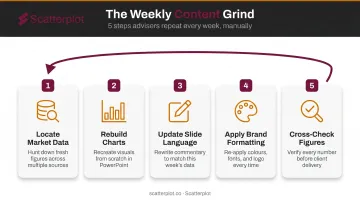
This repeats weekly or monthly. For an adviser with 80 clients, the volume is relentless.
The Consistency and Credibility Gap
When content is built manually under time pressure, quality varies. Charts pulled from different sources have different visual styles. Language gets recycled without updating the numbers. Disclosures get added inconsistently.
FPA Journal research found that trust and commitment in client-planner relationships are directly tied to communication quality — not just financial outcomes. Materials that look inconsistent or feel dated work against that trust before a word is spoken.
The Competitive Expectation Gap
Clients and prospects expect polished, current, data-backed materials. This isn't optional anymore. Capgemini's 2022 World Wealth Report noted that high-net-worth individuals increasingly demand digital capabilities from their wealth managers while still valuing human interaction.
An adviser who arrives at a meeting with a generic or visually inconsistent deck is signaling something — even if unintentionally.
Content automation removes the production bottleneck. When charts update automatically and decks arrive ready to present, the adviser's time shifts back toward the conversations that actually move client relationships forward.
How Content Automation Works in Investment Services
Content automation connects live or daily-refreshed data sources to pre-built content templates, applies brand rules, and outputs finished materials on a defined schedule. The adviser always has current, consistent, client-ready content available — without touching the workflow manually.
Step 1: Data Ingestion and Refresh
The process starts with structured data feeds that refresh on a defined schedule — daily, weekly, or in some cases real-time. These feeds pull updated figures for the metrics the adviser's content covers: equity index performance, interest rate movements, inflation data, sector returns, and economic indicators.
The data source quality matters here. Inaccurate or delayed data upstream produces inaccurate output downstream. WealthManagement.com has described how client portals can use live feeds from multiple custodians to deliver reports, commentary, and materials automatically — the same principle applies in content automation.
Step 2: Template Mapping and Content Generation
Updated data maps automatically to pre-configured content templates — chart layouts, slide structures, commentary frameworks — which populate with current figures and generate formatted visuals. This is where brand rules are applied:
- Logo placement and sizing
- Color schemes and typography standards
- Disclosure language
- Slide structure and visual hierarchy
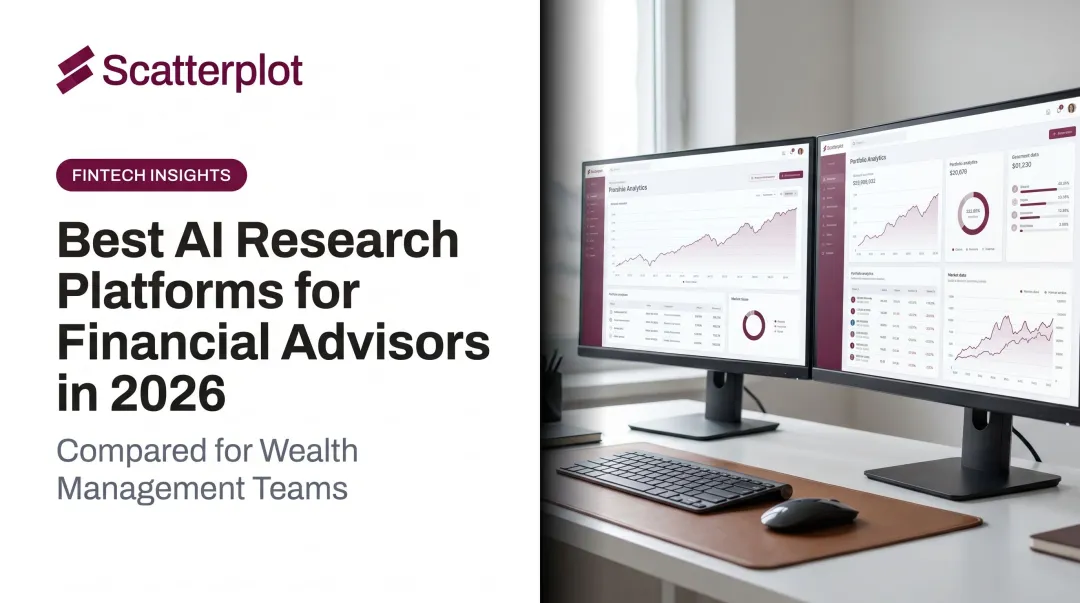
Platforms like Scatterplot are purpose-built for this step in the investment context. Scatterplot delivers daily-updated, fully branded slides with guided talking points — specifically designed so advisers never have to rebuild charts or reformat decks from scratch. Advisers configure their brand settings once (logo, colors, disclosure language), and every output reflects those standards automatically.
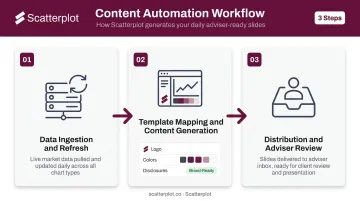
Step 3: Distribution and Adviser Review
Once generated, content is published to a platform library for immediate access. In Scatterplot's case, advisers browse a curated slide library, select the charts and materials relevant to their upcoming meetings, and either download the deck as a PDF or present directly from the platform.
The adviser's role shifts from builder to reviewer and communicator. They scan the output for relevance, decide which materials fit which clients, and focus their judgment on the conversation — not on slide production.
Key Use Cases and Factors That Drive Effectiveness
Primary Use Cases in an Advisory Practice
Content automation adds the most value in recurring, structured communication scenarios:
- Weekly or monthly client meeting decks that need current market context without being rebuilt each time
- Market update communications during periods of volatility, when clients need timely, clear information
- Onboarding presentations that explain the firm's investment philosophy against a live market backdrop
- Quarterly performance reviews that contextualize a client's portfolio against broader market conditions
The common thread: recurring data, repeatable format, and a clear communication goal.
Factors That Determine Effectiveness
Not all content automation implementations deliver the same results. Three factors matter most:
| Factor | What to Look For |
|---|---|
| Data quality | Reliable, regularly refreshed feeds from credible sources |
| Template design | Built for actual client conversations, not generic visuals |
| Brand customization | Output reflects the firm's identity, not a generic platform look |
Of these, template design and cadence are closely linked — which brings up a practical question most advisers face early on.
Frequency and Trigger Logic
Automation is most valuable when it runs on a cadence that matches the adviser's communication rhythm. An adviser who meets clients weekly needs daily-refreshed materials; one who does quarterly reviews can work with less frequent updates. The right fit depends entirely on how the adviser already communicates.
The system should align to the adviser's workflow — not force the adviser to adapt to the platform's schedule.
Common Misconceptions About Content Automation
"Clients Will Recognize It as Templated"
This is the most common concern, and it misunderstands how purpose-built investment content automation works. Well-designed systems are specifically built for brand customization — the adviser's logo, colors, disclosure language, and content selection shape every output. The automation handles the data and design work, while the relationship layer remains entirely the adviser's.
"It Removes the Expertise from the Relationship"
The opposite is true. Automation removes low-value production tasks — data sourcing, chart rebuilding, formatting — so the adviser can bring more focus and depth to high-value conversations. What advisers do with that recovered time is where the expertise actually shows up.
Kitces' analysis of 12,000 meeting transcripts found that client sentiment improved by about 1 point on a 10-point scale during human-adviser sessions, with high-emotional-intelligence advisers improving it by 1.14 points compared to 0.59 points for lower-scoring peers. No automated content system replicates that. Nor should it try.

That distinction points directly to where automation has real limits advisers should understand clearly.
Where Automation Is Genuinely Not Sufficient
Automation has real limits that advisers should understand clearly:
- It cannot respond to unexpected market events with the nuance a specific client may need in that moment
- It cannot adapt in real time to a client's emotional state or unique portfolio situation
- It is not a substitute for the adviser's narrative judgment in complex conversations
- Compliance obligations don't transfer to the platform — advisers remain responsible for the accuracy and appropriateness of everything shared with clients
Used well, automation handles the preparation. The adviser handles what no template can — reading the room, adjusting the narrative, and making the conversation meaningful.
Conclusion
Content automation takes the repetitive, time-consuming work of building and updating client-facing materials off the adviser's plate and replaces it with a reliable, always-current, branded content pipeline that runs without manual effort.
Treat it as infrastructure for communication — the same way you'd treat a CRM or a portfolio reporting tool. Choose a system built specifically for investment content, one that reflects your brand, embeds your compliance language, and delivers materials that are genuinely ready to use. Platforms like Scatterplot are designed for exactly that: daily-updated, fully branded slides your clients can see the same day markets move. Then use the time it saves to do what automation can't — strengthen the quality of your client relationships.
Disclaimer
The content on this site is for informational and educational purposes only and does not constitute financial, investment, legal, or tax advice. It should not be relied upon as the basis for any investment decision. Past performance is not indicative of future results. Always consult a qualified financial professional before making any financial decisions.
Frequently Asked Questions
What are the 4 stages of automation?
Parasuraman, Sheridan, and Wickens' foundational automation model defines four function classes: information acquisition, information analysis, decision/action selection, and action implementation. Investment content automation typically operates at stages 1 and 2 — ingesting data and generating formatted outputs — with human review before client distribution.
What types of investment content can be automated?
Market update slides, economic data charts, client meeting decks, portfolio context visuals, and performance review materials are all strong candidates. Any content that draws on recurring structured data and follows a repeatable format can be automated effectively.
How is investment content automation different from using a general AI tool?
General AI tools require a human to prompt, review, and format output each time. Purpose-built content automation platforms pull live data, apply brand templates, and deliver finished materials on a schedule — no manual triggering required each cycle.
Can automated investment content be customized with a firm's branding?
Yes. Purpose-built platforms like Scatterplot are designed specifically for this — advisers configure their logo, colors, and disclosure language once, and every output reflects those settings automatically without additional design work.
Does automated investment content need to meet compliance requirements?
Compliance obligations remain with the adviser and firm. SEC and FINRA rules require that client-facing communications be fair, balanced, and non-misleading regardless of how they were produced. Well-designed platforms embed disclosure language directly in templates — advisers should still verify every output against their firm's compliance standards before distribution.
How much time can content automation realistically save a financial adviser?
Kitces Research puts meeting preparation at 5.3 hours per week for the average lead adviser, with nearly 4.2 additional hours spent on administrative tasks. Content automation directly reduces that preparation time by handling data sourcing, chart building, and deck formatting before every client meeting.