Introduction
Most financial advisors already know their clients are different. What many underestimate is how much those differences should reshape how they communicate — not just what advice they give.
A Baby Boomer nearing retirement and a Millennial in wealth accumulation mode may hold similar portfolio sizes, yet expect entirely different advisor experiences. One wants formal quarterly reviews and structured market updates; the other wants digital content, informal check-ins, and accessible explanations across multiple channels.
Those mismatched expectations have real consequences. Research from the FPA Journal found that clients generally cannot evaluate the quality of financial advice directly — so they judge their advisor by how communication makes them feel. Satisfaction, trust, and long-term retention all hinge on whether clients feel consistently understood and informed.
This article covers how generational demographics should shape communication strategy, which communication types produce the strongest outcomes, and how to build a cadence that works across your entire client base.
Key Takeaways
- Generational differences in communication preferences — channels, format, and frequency — directly affect advisor trust and retention.
- Baby Boomers favor formal meetings and email; Gen X leans toward efficient digital communication; Millennials expect a broader, multi-channel mix.
- Investment-related educational communications and scheduled meetings are the two highest-impact communication types for building long-term client commitment.
- Advisors who retain clients use a structured, proactive communication cadence rather than waiting for clients to reach out.
Why Client Demographics Should Shape Your Communication Approach
Demographics aren't just background data for client files. Age, wealth stage, digital comfort, and life priorities directly influence which channels clients pay attention to, how often they want to hear from you, and what kind of content they actually value.
This matters more now than it did a decade ago. The advisor client base is actively shifting across generational lines — older clients are in wealth preservation or distribution mode while younger investors are entering prime accumulation years.
According to Cerulli Associates, $84.4 trillion in wealth is expected to transfer through 2045, with Baby Boomers accounting for more than $53 trillion of that total. Gen X stands to inherit nearly $30 trillion and Millennials nearly $28 trillion.
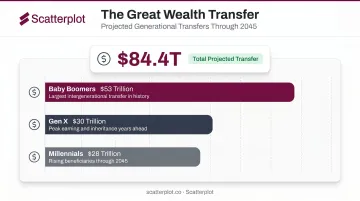
The practical consequence: advisors now manage communication expectations across multiple generational segments simultaneously — often within the same practice, sometimes within the same household.
That mismatch carries real costs. When advisors use the wrong channel or wrong tone for a client segment, it creates an impression of indifference — even when the underlying advice is sound. Since clients can't easily evaluate advice quality on their own, perception fills the gap. Poor communication doesn't just frustrate clients; it erodes trust that takes years to rebuild.
How Different Generations Prefer to Communicate With Their Advisor
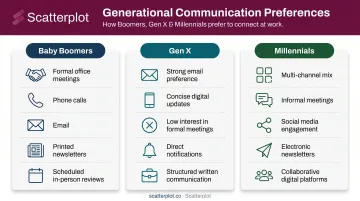
Advisors typically serve at least three distinct generational cohorts — Baby Boomers (born roughly 1946–1964), Gen X (1965–1980), and Millennials (1981–1996) — each with distinct expectations. Research summarized by Kitces from the Beddoes Institute provides one of the clearest generational maps available for advisor communication preferences.
Baby Boomers
Boomers place high value on formal, relationship-driven communication. Their preferences lean toward:
- In-person meetings at the advisor's office
- Phone calls for substantive conversations
- Email for written updates and materials
- Printed or electronic newsletters (roughly 1 in 3 express interest in printed materials)
The Beddoes Institute data shows Boomers have significantly stronger preferences for formal office meetings compared to younger cohorts. They respond well to structured educational content — market updates, economic context, portfolio explanations — because it reinforces the advisor's expertise and the value of the relationship. Social media and digital apps are not primary channels for this group, though email is broadly accepted.
Gen X
Gen X is the bridge generation: comfortable with both in-person and digital communication, but with a distinct lean toward efficiency. Key characteristics:
- Strong email preference over phone calls — and slightly over any single type of in-person meeting
- Lower interest in formal office meetings compared to Boomers (roughly half the preference rate)
- Receptive to electronic newsletters and concise, substantive written updates
- Time-pressed; they want advisors to get to the point without jargon
Gen X clients appreciate when communication is organized, provides clear context, and is accessible digitally without requiring them to carve out time for a formal sit-down. Short, high-quality written updates go further with this group than scheduled calls they have to reschedule twice.
Millennials and Gen Y
Millennials are the most demanding demographic for communication breadth. They expect engagement across multiple channels, and data shows they're measurably less satisfied when served through only a few. Specific patterns worth knowing:
- Formal office meetings: preferred at half the rate of Boomers
- Informal catch-ups: preferred at twice the rate of Boomers
- One-to-many channels: strong appetite for digital, social media, and advisor apps
- Electronic newsletters: preferred over printed materials by a wide margin (fewer than 1 in 4 want printed content)
In one-to-one communication, Millennials still value in-person meetings and email — just in more casual formats than Boomers expect. The channel mix matters, but so does tone and format within each channel.
Gen Z is beginning to emerge as a client demographic worth preparing for, with an estimated $11 trillion in projected wealth inheritance. Their preferences will likely extend the digital-first trend further, which means advisors who haven't built out multi-channel communication yet have a narrowing window to do so.
The Communication Types That Build Trust, Retention, and Referrals
Not all outreach is equally valuable. Research published in the FPA Journal by Cheng, Browning, and Gibson (2017), drawing on survey data from over 1,000 financial planning clients, found that specific communication types produce measurably different outcomes. Understanding the hierarchy lets advisors allocate effort more strategically.
Investment-Related Educational Communications
This category — market updates, economic context, portfolio explanations — is the highest-impact type for building client commitment. Higher frequencies of investment-related educational communications are positively associated with:
- Clients' likelihood of continuing to use their advisor
- The percentage of assets managed by the advisor
Why? Because financial advice is what economists call a "credence good" — clients can't easily evaluate its quality directly. Educational content on markets and investments fills that gap, making the advisor's expertise visible and tangible on an ongoing basis.
This is where structured visual content creates a practical advantage. Platforms like Scatterplot deliver daily-updated, branded investment charts and guided talking points — giving advisors a consistent, low-friction way to keep clients informed between meetings.
Scheduled Meetings
Across all outcome measures — satisfaction, trust, and commitment — scheduled meetings are the single most consistently impactful communication type. The research identifies a clear benchmark: approximately four scheduled meetings per year produces maximum value, after which incremental benefit diminishes.
The key distinction is how those meetings are run. Meetings used to educate, review progress, and connect personally outperform purely administrative check-ins.
Advisors who use meeting time to explain market context, revisit goals, and engage the client as a person — not just report numbers — see significantly stronger relationship outcomes.
Personal Touchpoints
Non-financial communication — birthday notes, congratulations messages, holiday cards — has a meaningful positive effect on satisfaction and referral behavior. These personal touchpoints outperform non-investment educational content (like Social Security updates) when it comes to building emotional connection.
One important caution from the research: interest and hobby communications should be used sparingly. Overuse of content about golf, wine, or personal interests is negatively associated with trust and satisfaction. Clients tend to read excessive lifestyle outreach as performative rather than genuine. The principle is quality over frequency — and relevance over relatability-signaling.
Building a Communication Cadence That Works Across Client Segments
Advisors who retain clients through difficult markets share a common trait: they communicate before clients have a reason to worry. A structured cadence makes that consistency repeatable.
The Baseline Framework
A practical starting point for most practices:
- Quarterly: Scheduled meetings or substantive check-ins (phone or in-person)
- Monthly: Investment-related educational updates (market context, economic data, portfolio themes)
- Periodic: Personal touchpoints — birthday notes, milestone acknowledgments, meaningful congratulations
- As needed: Volatility-period outreach, triggered by your calendar, not client panic calls
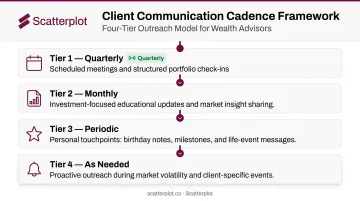
This maps to the research benchmarks: four meetings per year, regular educational content, and personal notes used purposefully.
Building the Cadence Around Client Preferences
The cadence only works if it's mapped to how each client actually wants to communicate. At onboarding, advisors should ask directly:
- What's your preferred channel for updates — email, phone, in-person?
- How often do you want to hear from us?
- What kind of content is most useful to you — market updates, planning milestones, both?
Record these preferences in your CRM and build the communication plan around them. This turns outreach from guesswork into a personalized system.
Channel Breadth vs. Volume
Research on channel breadth shows satisfaction rises as the number of communication channels increases, with optimal impact around five distinct channels — for example: formal meeting, informal check-in, email, educational newsletter, and personal note. Millennials in particular show measurably lower satisfaction when served through only three or four channels.
The nuance: volume without personalization becomes noise. Consistent, purposeful outreach in the right channels outperforms high-frequency generic blasts every time. Quality of contact drives trust — quantity alone does not.
Volatility as a Test of the System
Market downturns are the highest-stakes communication moments in any advisor relationship. Proactive outreach during turbulent periods — before clients pick up the phone — is what separates advisors who hold relationships from those who scramble to repair them.
A structured cadence makes this automatic. When a monthly market update is already scheduled and a quarterly meeting is on the calendar, volatility outreach becomes part of the system, not a crisis response. Three things that support this:
- A pre-written market context email ready to deploy when volatility spikes
- A standing quarterly meeting that creates a natural touchpoint without urgency
- Educational content already in rotation, so clients associate you with clarity — not just bad news
Common Communication Mistakes Financial Advisors Make
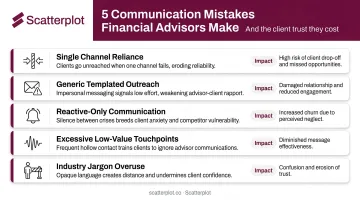
Most communication failures fall into predictable patterns. The most damaging:
- Relying on a single channel. Gen X clients tend to prefer email over formal meetings, while Millennials expect a multi-channel mix. Advisors who stick to one format signal rigidity, not client focus.
- Generic, firm-stamped outreach. Holiday cards only land if personally signed — mass-produced versions produce no meaningful impact. The same applies to templated email blasts: they feel like broadcasts, not conversations.
- Only reaching out when something's wrong. Advisors who contact clients mainly during market volatility train them to associate advisor calls with stress. Consistent outreach during calm periods builds the trust that holds when markets turn.
- Too many low-value touchpoints. Excessive interest- or hobby-based communications without substance erodes trust. Excessive lifestyle outreach backfires. Reach out with purpose — meaningful, timely, and matched to what the client actually cares about.
- Industry jargon instead of plain language. Not every client shares the same financial literacy. Advisors who default to investment-industry terminology create distance rather than confidence. Clear, accessible language makes the relationship feel inclusive, not transactional.
Disclaimer
The content on this site is for informational and educational purposes only and does not constitute financial, investment, legal, or tax advice. It should not be relied upon as the basis for any investment decision. Past performance is not indicative of future results. Always consult a qualified financial professional before making any financial decisions.
Frequently Asked Questions
How often should a financial advisor communicate with clients?
Research supports approximately four scheduled meetings per year as the sweet spot for maximizing satisfaction and commitment, supplemented by monthly educational updates and periodic personal touchpoints. The ideal frequency ultimately depends on each client's stated preferences — ask directly and document the answer.
What communication channels do different generations of clients prefer?
Baby Boomers favor formal in-person meetings and email; Gen X leans toward email and efficiency-focused digital communication; Millennials expect a broader mix including social media, informal meetings, and electronic content. Individual preferences always take priority over generational generalizations — treat these as starting assumptions, not fixed rules.
What type of communication is most effective for building client trust?
Investment-related educational content and scheduled meetings most reliably build trust and long-term commitment. Educational content on markets and the economy makes the advisor's expertise visible; structured meetings create the consistency that clients equate with reliability.
How does client communication affect retention and referrals?
Communication quality and consistency directly influence both. Clients who receive regular investment education and personal touchpoints are more likely to continue with their advisor and refer peers. The FPA Journal research found investment-related educational content is specifically associated with higher assets entrusted to the advisor over time.
What communication mistakes do financial advisors most commonly make?
The most damaging: defaulting to a single channel, using jargon-heavy language, sending generic templated messages, and communicating only reactively during market stress. Each of these erodes the trust and satisfaction that drive long-term relationships — a structured communication plan addresses all of them.