The stakes are real. According to YCharts' 2024 Advisor-Client Communication Survey, 88% of clients say communication frequency and style would influence whether they continue working with their advisor, while 89% say it affects whether they'd refer friends or family. Yet nearly half of all clients wish their advisor reached out more often.
Templates solve this problem — not by replacing personal communication, but by making consistent, quality outreach achievable at scale. This article delivers 12 ready-to-use text and email templates organized by situation, from appointment reminders to market volatility updates.
One important note before you start copying: every template here is a starting point. Customize with client-specific details, and always clear any templated communications through your firm's compliance process before use.
Key Takeaways
- Text templates work best for short, time-sensitive touchpoints: confirmations, reminders, market reassurances, and relationship check-ins
- Email templates are better suited for meeting recaps, market commentary, quarterly reviews, and business development outreach
- Personalization matters — reference client goals, past conversations, or key milestones wherever possible
- Compliance is non-negotiable: archive messages, follow firm policies, and confirm opt-in before texting
What Makes a Great Financial Advisor Communication Template
Every effective advisor template does two things: it delivers value to the client (information, reassurance, or next steps), and it prompts a clear action (confirm, reply, schedule, read). Templates that just "check in" underperform because they don't give the client anything to do with the message.
Text vs. Email: Choosing the Right Channel
The channel shapes the message as much as the content does.
- Text: Short, urgent, time-sensitive. Under 160 characters when possible. Best for confirmations, reminders, and quick reassurances
- Email: Longer content, attachments, formatted summaries, and anything that needs documentation. Better for market updates, meeting recaps, and planning insights
- Combined approach: A text alert followed by a detailed email drives higher engagement than either channel alone
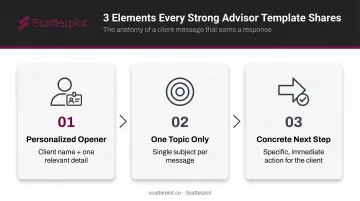
The Three Elements Every Strong Template Shares
The templates that consistently get responses share the same structure:
- A personalized opener — client name plus one relevant detail (a goal, milestone, or recent conversation)
- One topic only — stick to a single subject per message; splitting focus between two topics reduces reply rates
- A concrete next step — a specific action the client can take right away, not a vague "let me know if you have questions"
Text Message Templates for Financial Advisors
SMS gets read. According to EZ Texting's 2026 Consumer Texting Behavior Report, 87% of consumers read text messages within 15 minutes of receipt. That immediacy makes texting the right channel for high-priority, time-sensitive touchpoints.
Before texting any client: confirm you've obtained consent, are using a compliant archiving platform, and have reviewed your firm's texting policies.
Appointment & Admin Texts
Template 1 — Meeting Confirmation
Hi [Client First Name], just confirming our [meeting type] on [Day, Date] at [Time] via [location/video link]. Reply CONFIRM or let me know if you need to reschedule. Looking forward to it!
Customization tip: Add a one-line agenda teaser ("We'll be covering your retirement timeline and a few portfolio updates") — clients who know what to expect show up better prepared and more engaged.
Template 2 — Document Follow-Up Reminder
Hi [Client First Name], a quick reminder that we still need your [document type] before [deadline date]. You can submit securely here: [link]. Let me know if you have any questions!
Customization tip: Word choice matters more than it seems. "We still need" reads as collaborative; "you have not returned" reads as a collections notice. Small edits like this reduce friction and improve completion rates.
Relationship & Engagement Texts
Template 3 — Quarterly Review Reminder
Hi [Client First Name], your quarterly review is coming up on [date]. Before we meet, is there anything specific you'd like to cover — any changes at home or questions on your mind?
Customization tip: Reference a specific goal or milestone from your last meeting ("Last time we talked about accelerating your mortgage payoff — I'll have an update ready"). That one detail transforms a calendar reminder into a personalized touchpoint.
Template 4 — Birthday or Life Milestone Check-In
Hi [Client First Name], wishing you a wonderful [birthday/anniversary/retirement]! Hope it's a great day — talk soon.
Customization tip: Don't pitch anything here. The entire purpose is showing the client they're remembered as a person, not just an account number. Keep it short and genuine — that's what lands.
Market & Business Development Texts
Template 5 — Market Volatility Reassurance
Hi [Client First Name], I know today's market moves can feel unsettling. Your portfolio is being monitored and your plan accounts for periods like this. I'll reach out if anything needs attention — but feel free to call me anytime.
Customization tip: Send this within hours of a major market event. A reassurance text sent two days later reads as reactive, not proactive — and loses most of its value.
Template 6 — Referral Request
Hi [Client First Name], really glad we were able to [milestone/outcome] together. If you know anyone who might benefit from this kind of guidance, I'd love an introduction — even a quick text intro works great.
Customization tip: Send this right after a clear positive signal — a compliment, a milestone achieved, a review that went well. A referral ask that follows genuine momentum feels natural; one that arrives out of nowhere rarely does.
Email Templates for Financial Advisors
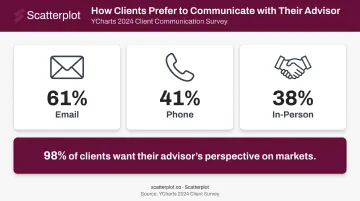
Email remains the top channel for advisor-client communication. YCharts' 2024 survey found 61% of clients prefer email for hearing from their advisor — ahead of phone calls (41%) and in-person meetings (38%). The same survey found 98% of clients want their advisor's perspective on markets and the economy.
Email's advantage over text is depth: formatted summaries, charts, attachments, links, and a documented communication record all in one place.
The six templates below cover the most common email touchpoints — from onboarding to referral requests — organized by use case.
Onboarding & Follow-Up Emails
Template 7 — New Client Welcome Email
Subject: Welcome — Here's What to Expect Next
Hi [Client First Name],
It was great meeting with you. I'm looking forward to working together toward [goal 1] and [goal 2].
Here's what happens next:
- Complete your onboarding documents: [secure portal link]
- Schedule your first planning session: [calendar link]
- Set up your client portal: [portal link]
Going forward, you can expect to hear from me [monthly/quarterly] with updates on your portfolio and planning. I typically respond to emails within [X] business days and am always reachable at [phone/email].
Please don't hesitate to reach out with any questions.
[Advisor Name]
Customization tip: Reference one specific detail from your first conversation ("You mentioned wanting to simplify your finances before your daughter's wedding — that's top of my list"). It signals the client was heard, not processed.
Template 8 — Post-Meeting Recap Email
Subject: Recap from Our Meeting on [Date]
Hi [Client First Name],
Thanks for your time today. Here's a quick summary for your records:
What we discussed:
- [Discussion point 1]
- [Discussion point 2]
Decisions made:
- [Decision 1]
Action items:
- [Client name]: [Task] by [date]
- [Advisor name]: [Task] by [date]
Next meeting: [Date/time or "I'll send a calendar invite for our next quarterly review"]
Let me know if anything needs clarifying.
[Advisor Name]
Customization tip: Keep it to 3–5 bullet points. This is a reference document for the client, not a transcript. If a client has to scroll to find their action item, the recap is too long.
Market Updates & Portfolio Review Emails
Template 9 — Market Update Email
Subject: Market Update: What's Happening and What It Means for You
Hi [Client First Name],
[2-3 sentence plain-language summary of recent market conditions — e.g., "Equity markets declined roughly X% this week amid concerns about..."]
What this means for your portfolio: [1-2 sentences connecting the market environment to the client's specific strategy, risk profile, or timeline — e.g., "Your allocation is positioned to weather short-term volatility, and your timeline gives us room to stay the course."]
What I'm watching: [1 brief forward-looking point]
I'll be reviewing portfolios carefully over the coming days. If you'd like to talk through any of this, [schedule a call here: calendar link] or simply reply to this email.
[Advisor Name]
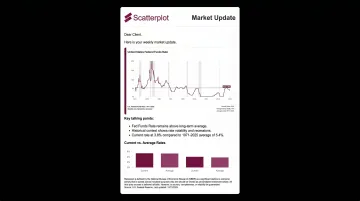
Customization tip: A branded market visual does more than text commentary alone — clients can see the data, not just read about it. Tools like Scatterplot deliver daily-updated charts with your firm's logo, colors, and disclosures already applied, plus talking points per slide, so there's nothing to build from scratch.
Template 10 — Quarterly Portfolio Review Email
Subject: Your Q[X] [Year] Portfolio Review — and What's Next
Hi [Client First Name],
Here's a summary of your portfolio's performance this quarter and where things stand relative to your goals.
Performance highlights:
- [Key metric or benchmark reference — described in plain language]
- [Notable positive or area of attention]
Progress toward your goals:
- [Goal 1, e.g., retirement target date]: [On track / Ahead / Reviewing]
Recommended adjustments (if any):
- [Rebalancing note, tax-loss consideration, or "No changes recommended at this time"]
I'd love to walk through this together. [Book your review here: calendar link]
[Advisor Name]
Customization tip: Frame performance around the client's goals, not just benchmarks. "You're on track for your target retirement date" lands differently than "the portfolio returned X% vs. the index." Goal-framing makes the update feel relevant to their life, not just their account.
Business Development Emails
Template 11 — Value-Add / Financial Planning Tips Email
Subject: One Thing Worth Knowing This Month: [Topic]
Hi [Client First Name],
One quick insight this month that I thought was worth sharing given where you are in your planning:
[Planning tip or market insight — e.g., "If you're within 5 years of retirement, now is a good time to review your Social Security claiming strategy before year-end."]
Why it matters for you: [1–2 sentences connecting the tip to the client's specific situation or goals]
If you have questions or want to talk through how this applies to your plan, just reply here or [schedule a 15-minute call: calendar link].
[Advisor Name]
Customization tip: Segment before sending. A required minimum distribution reminder resonates with clients in their 70s and is irrelevant noise to a 38-year-old accumulator. One well-targeted email beats five generic ones.
Template 12 — Referral Request Email
Subject: A Quick Ask — and Thank You
Hi [Client First Name],
I wanted to reach out and say how much I've enjoyed working with you, especially [recent milestone or outcome — e.g., "reaching your savings target ahead of schedule"].
I'm selective about taking on new clients, and I find the best relationships often come through introductions from people I already work with.
If you know anyone — a colleague, friend, or family member — who might benefit from this kind of financial guidance, I'd be honored by an introduction. Even a quick email intro or a "you should talk to my advisor" text is plenty.
Thank you for your trust. It means a lot.
[Advisor Name]
Customization tip: Send 1–2 weeks after a successful outcome, not immediately after. Client satisfaction peaks shortly after a positive milestone — that's your window.
Tips for Personalizing and Sending These Templates
Segment First, Then Send
Before using any template, segment your client list. A market volatility message sent to a conservative income-oriented retiree should sound different than one sent to a 40-year-old with a 25-year growth horizon. At minimum, segment by:
- Life stage (accumulator, pre-retiree, retiree)
- Portfolio type (growth, income, balanced)
- Relationship status (new client, active, at-risk of disengagement)
Compliance and Recordkeeping
This is not optional. Key requirements to understand:
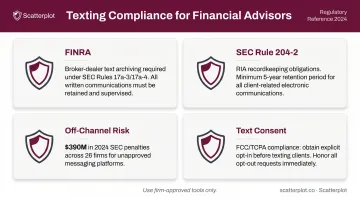
- For broker-dealers: FINRA Regulatory Notice 17-18 requires firms to ensure text messages and chat communications can be retained under SEC Rules 17a-3 and 17a-4 before using those channels
- For RIAs: SEC Rule 204-2 requires investment advisers to maintain accurate books and records, with certain records kept for at least five years
- Off-channel risk is real: The SEC charged 26 firms with recordkeeping failures in 2024, resulting in over $390 million in penalties — primarily for using personal devices and unapproved apps
- Text consent: FCC/TCPA rules and CTIA messaging guidelines require obtaining consumer consent before sending business texts and providing clear opt-out mechanisms
Use firm-approved email tools and a compliant texting platform that integrates with your archiving system. Personal devices and consumer messaging apps create regulatory exposure regardless of what was said.
Use Your CRM to Customize at Scale
Storing 2–3 key client details in your CRM — current primary goal, last interaction date, upcoming milestone — lets you customize templates in under a minute. Automation handles the timing (birthday texts, pre-review reminders); your judgment handles the personalization. Together, they let you stay consistently present across a large book of business without sacrificing the personal touch that retains clients.
Disclaimer
The content on this site is for informational and educational purposes only and does not constitute financial, investment, legal, or tax advice. It should not be relied upon as the basis for any investment decision. Past performance is not indicative of future results. Always consult a qualified financial professional before making any financial decisions.
Frequently Asked Questions
Can financial advisors legally text their clients?
Yes, with conditions. FINRA and SEC rules focus on recordkeeping — firms must be able to archive and supervise text communications before using them for business. On the consumer side, FCC/TCPA and CTIA guidelines require obtaining consumer consent before sending business texts and providing opt-out options. Always follow your firm's written texting policy and use a compliant platform.
How often should financial advisors send texts or emails to clients?
YCharts' 2024 data shows 79% of clients prefer at least quarterly contact, and 47% of those with over $500,000 under advisory want monthly outreach. Limit texts to 1–2 per month unless event-triggered (market volatility, appointments). Emails can run weekly to monthly, but relevance always matters more than volume.
Should financial advisors use the same message for both texts and emails?
The same topic can span both channels, but the format must differ. Texts should be brief and action-oriented (under 160 characters when possible). Emails allow for context, formatting, and attachments. A useful pattern: use a text to flag that an important email is coming, then deliver the full update via email.
How do I personalize templates without spending too much time on each message?
Keep your CRM updated with 2–3 key details per client: their primary goal, last interaction, and next upcoming milestone. Reference just one of those details per message. That single specific touch creates a personal feel without requiring a custom message from scratch every time.
What's the best time to send client texts or emails?
General research points to mid-morning on weekdays — Tuesday through Thursday between 9 AM and noon — as the window with the highest open and response rates. For market-triggered messages (volatility reassurance, urgent updates), send promptly regardless of the clock.
Do these templates need compliance review before use?
Most broker-dealer and RIA firm policies require pre-approval of templated client communications. Submit these to your compliance officer before deploying, and keep a record of the approval alongside archived outbound messages.