Introduction
Global equity market capitalization stood at $126.7 trillion and fixed income outstanding at $145.1 trillion in 2024, per SIFMA's Capital Markets Fact Book — roughly $271.8 trillion in total securities across markets that are deeply intertwined.
For wealth advisers, that scale creates both opportunity and real complexity. Clients increasingly ask about global diversification — international bonds, foreign equities, emerging market exposure. The mechanics behind these markets differ meaningfully from domestic investing, and client conversations require more precision than "just buy an international ETF."
This guide covers the two pillars of international markets: bonds and equities. It explains the key instrument types, where the risks actually live, what the diversification data shows, and how to translate that knowledge into clear, credible conversations with clients.
Key Takeaways
- International bonds include Eurobonds, foreign bonds, global bonds, and Brady bonds — each with distinct currency and regulatory profiles
- Non-U.S. equities represent roughly 57.4% of global equity market cap, making domestic-only portfolios a meaningful geographic underweight
- Currency risk, political risk, and liquidity risk are the three core risks advisers need to communicate clearly to clients — not just bury in disclosures
- Hedged international bond allocations have historically reduced portfolio volatility; Vanguard research supports a 30% international bond allocation within a fixed income sleeve
- International-equity funds attracted more than $57 billion in net inflows in 2025 — adviser interest is accelerating
Types of International Bonds Advisers Should Know
An international bond is any bond issued by an entity outside its home country, or sold to investors across national borders. That simple definition matters enormously because it determines which currency the investor is exposed to, which regulatory regime governs the issuance, and what credit framework applies.
Three main categories show up in adviser portfolios.
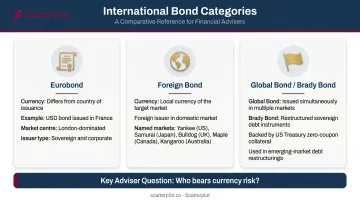
Eurobonds
Despite the name, Eurobonds have nothing to do with the euro currency. A Eurobond is denominated in a currency different from that of the country where it's issued — for example, a U.S. dollar-denominated bond issued in France, or a Japanese yen bond issued in Germany.
According to ICMA, the market originated with the Autostrade issue in July 1963 — a $15 million, 15-year bond at 5.5%, led by SG Warburg. Maturities in the 7–15 year range are the most common for internationally issued bonds. BIS research identifies London as the home of roughly three-quarters of primary and secondary international bond market activity.
The BIS/FRED dataset shows $33.9 trillion in international debt securities outstanding as of Q4 2025, which puts the scale of the cross-border bond market in context.
Foreign Bonds
Foreign bonds differ from Eurobonds in one critical way: they are denominated in the local currency of the country where they're issued, but sold by a foreign issuer. Several named markets exist:
- Yankee bonds — USD-denominated, issued in the U.S. by a non-U.S. entity
- Samurai bonds — yen-denominated, issued in Japan by nonresidents
- Bulldog bonds — GBP-denominated, issued in the UK
- Maple bonds — CAD-denominated, issued in Canada by foreign borrowers
- Kangaroo bonds — AUD-denominated, issued in Australia
The naming conventions are market shorthand, but the underlying principle is consistent: the issuer is foreign, the currency is local.
Global Bonds and Brady Bonds
Global bonds can be issued and traded simultaneously across multiple markets and currencies. A French company might issue a USD-denominated global bond offered to investors in both the U.S. and Japan — combining the reach of a Eurobond with the regulatory structure of a domestic offering.
Brady bonds occupy a different corner of the market. Introduced in March 1989 by U.S. Treasury Secretary Nicholas Brady, the plan restructured distressed sovereign debt from developing nations into tradable securities, often collateralized by zero-coupon U.S. Treasuries. According to the IMF, 17 countries undertook Brady restructurings between 1990 and 1998, with the largest being:
- Mexico ($54.3B)
- Brazil ($43.3B)
- Argentina ($28.5B)
Most Brady bonds carry below-investment-grade ratings, so credit assessment is essential before including them in client portfolios.
The key distinction across all three types: currency denomination vs. country of issuance. For advisers, that single variable drives the currency risk conversation — specifically, whether the client is bearing exchange rate exposure and under which regulatory framework the bond was issued.
International Equity Markets: Key Features and Major Players
International equity markets are exchanges and trading venues where shares of publicly listed companies outside an investor's home country are bought and sold. They offer ownership exposure to economies, sectors, and growth trends unavailable in a U.S.-only portfolio.
The World Federation of Exchanges reports $151.94 trillion in global equity market capitalization at end-2025, across 49,054 listed companies on member exchanges. Based on SIFMA's 2023 data showing U.S. equity markets at 42.6% of $115 trillion global market cap, non-U.S. equities represent approximately 57.4% of global equity market capitalization. For advisers building diversified portfolios, that majority of listed global opportunity warrants a dedicated allocation.
Major Global Equity Regions
Advisers typically organize international equity exposure across three tiers:
| Region | Examples | Key Index |
|---|---|---|
| Developed Markets | Europe, Japan, Australia | MSCI EAFE (21 countries) |
| Emerging Markets | China, India, Brazil | MSCI EM (24 countries) |
| Frontier Markets | smaller/less liquid economies | MSCI Frontier |
The MSCI ACWI ex USA covers approximately 85% of the global equity opportunity set outside the U.S., with $37.85 trillion in market cap across 1,977 constituents as of late May 2026.
For most retail and mass-affluent clients, the practical access routes are:
- ADRs (American Depositary Receipts) — foreign shares traded on U.S. exchanges, removing currency conversion friction
- International ETFs and mutual funds — the most common and cost-effective vehicle for broad regional exposure
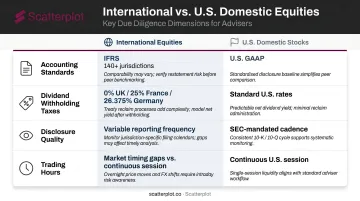
How International Equities Differ from Domestic Stocks
Advisers need to flag several structural differences before clients invest:
- Accounting standards — More than 140 jurisdictions use IFRS rather than U.S. GAAP, meaning financial statements are constructed differently
- Dividend withholding taxes — According to KPMG's 2025 Global Withholding Taxes guide, rates vary sharply: 0% in the UK, 25% in France, and up to 26.375% in Germany for non-treaty investors. Headline dividend yields may not reflect what a U.S. investor actually receives
- Disclosure quality — Corporate reporting frequency and transparency vary by market
- Trading hours — Most international markets are closed when U.S. markets open, creating pricing lags in ETFs and ADRs
Risks in International Bond and Equity Markets
International markets introduce a risk profile that differs meaningfully from domestic allocations. Advisers who can explain these risks clearly — not just disclose them — tend to retain clients through volatile periods.
The three primary risks to understand:
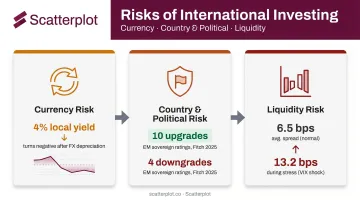
- Currency risk — exchange rate moves that amplify or erase local returns
- Country and political risk — sovereign instability, sanctions, and policy reversals
- Interest rate and liquidity risk — divergent central bank cycles and thin market depth
Currency Risk
Exchange rate movements can amplify or erase returns completely. A bond yielding 4% in local currency terms delivers a negative return to a U.S. investor if the foreign currency depreciates sufficiently against the dollar over the holding period. The reverse is equally true — currency appreciation can boost returns beyond the bond's yield.
That dynamic makes currency exposure an active decision, not a passive outcome — and advisers should be explicit about whether a client's international allocation is hedged or unhedged.
Country and Political Risk
Country risk encompasses political upheaval, fiscal crises, sanctions, policy reversals, and institutional instability. This risk runs highest in emerging and frontier markets, where rule-of-law frameworks and central bank independence are less established than in developed markets.
Fitch reported 10 upgrades and four downgrades in emerging market sovereign rating actions in 2025, led by sub-investment-grade frontier markets — a reminder that this risk is live and directionally variable.
Interest Rate and Liquidity Risk
Interest rate risk in international bonds follows the same mechanics as domestic bonds — rising rates depress prices — but the timing and magnitude depend on foreign central bank policy. The ECB, Bank of Japan, and Fed have been on divergent policy paths, creating meaningful variation in duration risk across regions.
Liquidity risk is a practical constraint in many international markets. BIS research covering 16 emerging market economies over 2004–2022 found average bid-ask spreads of 6.5 basis points in sovereign bonds. During stress periods — measured by a one-standard-deviation VIX shock — those spreads widened by an additional 6.7 basis points. Exiting large positions in frontier market bonds or small-cap international equities can move prices meaningfully.
The Case for International Diversification: What the Data Shows
The core diversification argument is straightforward: international bond and equity markets do not move in perfect correlation with U.S. markets. Adding them reduces overall portfolio volatility.
Vanguard research found that equity volatility was reduced most with 35%–55% allocations to international equities. The 10-year rolling correlation between U.S. and non-U.S. stocks rose from 0.51 in 1989 to 0.86 in 2020 — still meaningfully below 1.0, but tighter than in prior decades.
On the fixed income side, Vanguard adviser research supports a 30% international bond allocation within a fixed income sleeve to dampen portfolio volatility.
Currency Hedging: Isolating Fixed Income Characteristics
Unhedged international bonds can behave more like equity during stress — currency volatility overwhelms the yield signal. Hedging removes that noise.
BlackRock notes that U.S.-dollar-hedged global government bonds have historically delivered higher returns and lower volatility than comparable U.S.-only bond indices. For clients with a fixed income allocation that's meant to provide ballast, hedged international bonds serve that function. Unhedged positions require a different conversation about expected behavior.
Why Adviser Interest Is Rising Now
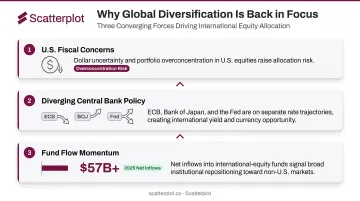
Several factors are converging to renew interest in international diversification:
- U.S. fiscal concerns and dollar uncertainty are prompting questions about over-concentration
- Diverging central bank policies (ECB, Bank of Japan, Fed) create differentiated return opportunities across regions
- Morningstar reported international-equity funds attracted more than $57 billion in net inflows in 2025 — their first sustained influx since 2021
The data points in one direction: the case for international exposure has grown more compelling, even as correlations have tightened from their pre-2000 lows.
Turning Market Knowledge into Client Conversations
Understanding international markets is the easier half of this challenge. The harder part is explaining them in a way that builds client confidence rather than confusion.
A three-question framework structures these conversations well:
- Where is the client's current geographic exposure? Most U.S.-based clients are heavily weighted toward domestic markets without realizing it
- What risks are they already taking on? Currency exposure through multinationals, EM debt in bond funds, foreign holdings through target-date funds — these often exist implicitly
- What diversification benefit could a modest international allocation add? Frame this with data, not assertions
The conversation lands better when supported by current visuals. A chart showing global bond yields across regions, or international equity performance versus the S&P 500 over rolling periods, gives clients something to anchor the discussion to. Without that, the conversation stays theoretical — and theoretical conversations rarely produce conviction.
That's the problem Scatterplot was built to solve. The platform gives wealth managers daily-updated, branded charts covering global market data — formatted for client-facing use and ready before the meeting starts. Built-in talking points mean the conversation framework comes with the visuals, so advisers spend less time building decks and more time in the actual discussion.
At $99/month with a 7-day free trial, it's a practical starting point for advisers who want international market coverage their clients can follow in real time.
Disclaimer
The content on this site is for informational and educational purposes only and does not constitute financial, investment, legal, or tax advice. It should not be relied upon as the basis for any investment decision. Past performance is not indicative of future results. Always consult a qualified financial professional before making any financial decisions.
Frequently Asked Questions
What is the difference between the bond market and the equity market?
Bond markets involve lending — investors become creditors who receive fixed interest payments and principal repayment at maturity. Equity markets involve ownership — investors become partial owners who share in profits and losses. International versions of both add currency risk and country risk on top of the standard return drivers.
What does Warren Buffett say about bonds?
In Berkshire Hathaway's 2017 shareholder letter, Buffett wrote: "It is a terrible mistake for investors with long-term horizons...to measure their investment 'risk' by their portfolio's ratio of bonds to stocks." His skepticism targets long-duration bonds in inflationary environments and reflects a preference for equities in long-term wealth building — not a direct critique of diversified international fixed income strategies.
What is the difference between a Eurobond and a foreign bond?
A Eurobond is denominated in a currency different from the country where it's issued (for example, a USD bond issued in France). A foreign bond is denominated in the local currency of the issuing country but sold by a foreign entity — a Yankee bond issued in USD in the U.S. by a German company is a classic example.
What are the main risks of investing in international bonds?
The four primary risks are currency risk, country/political risk, interest rate risk driven by foreign central bank policy, and liquidity risk. Hedging strategies and regional diversification can partially manage all four, but none can be eliminated entirely.
Should advisers include international bonds in client portfolios?
Research generally supports a meaningful international fixed income allocation for diversification. Vanguard's analysis suggests a 30% international allocation within the bond sleeve can reduce portfolio volatility. The appropriate size depends on the client's risk tolerance, time horizon, and existing geographic exposures.
What is currency hedging and why does it matter for international investments?
Currency hedging uses instruments like forward contracts to neutralize exchange rate movements on an international investment's return. For bonds specifically, hedging keeps the investment behaving like fixed income — predictable and yield-driven — rather than introducing equity-like volatility from currency swings that can dominate returns in either direction.